The Personality Atlas
THE CELEBRITY PERSONALITY ARCHIVE / Public service

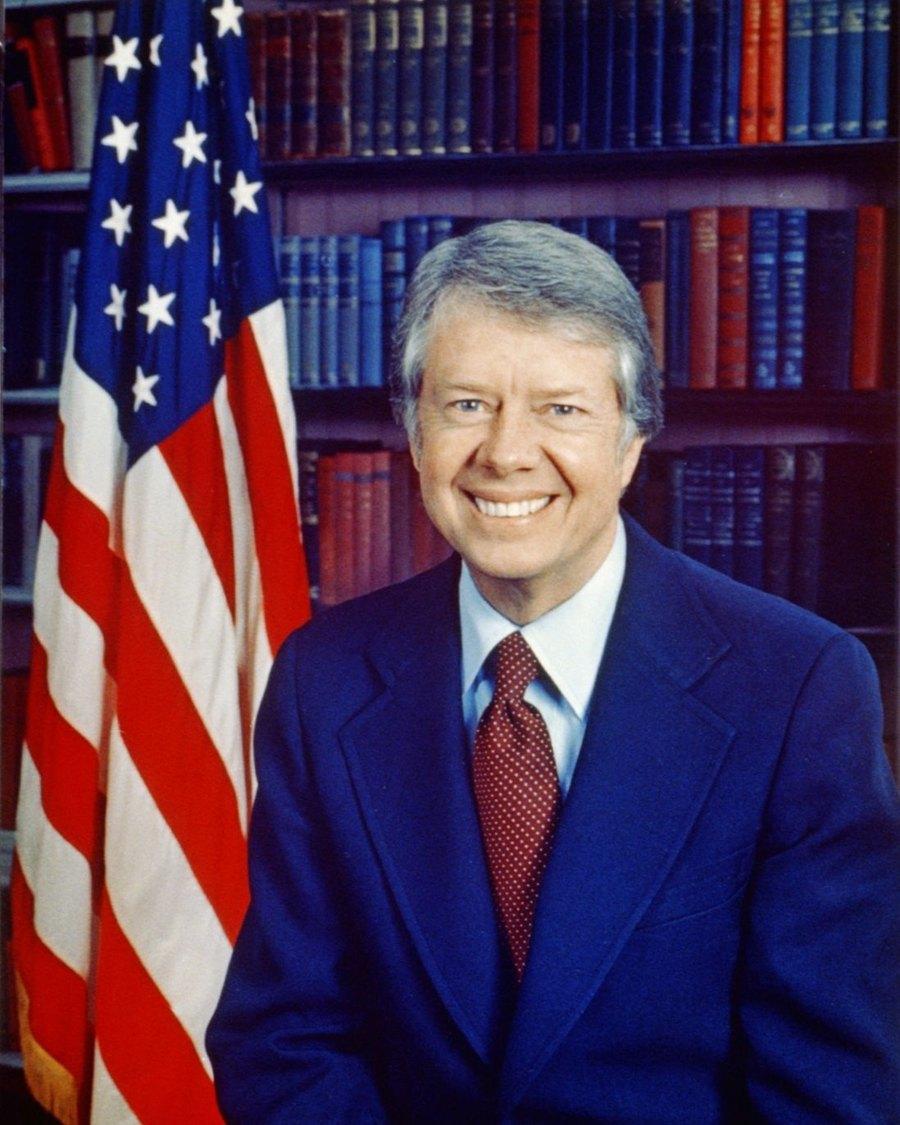
Jimmy Carter.

39th U.S. president and humanitarian

Jimmy Carter served in the Navy and ran his family’s peanut business before becoming Georgia’s governor and the 39th U.S. president. After leaving office, he and Rosalynn Carter founded The Carter Center and volunteered on Habitat for Humanity builds.

PROVISIONAL OPS CLASSIFICATIONFF-Ti/Si-SC/P(B)What does this mean?
PERSONALITY SYSTEMObjective Personality
LEAD FUNCTIONTi · Introverted Thinking
SECOND SAVIOR FUNCTIONSi · Introverted Sensing
MBTI EQUIVALENTINTP
01 / BEHIND THE CLASSIFICATION

The personality behind the fame.

How does a recorded OPS classification like FF-Ti/Si-SC/P(B) break down? Walk through nine coins and watch the proposed type take shape. These are deductions from the archived code, not independent evidence of typing accuracy.

Scroll below to see Jimmy Carter take shape.

STARTING POINT512 possible OPS typesEach type combines core functions, an animal order, and sexual modalities.
THE FINISH LINEFF-Ti/Si-SC/P(B)One recorded classification, decoded from its components.
Jimmy Carter’s HUMAN NEEDS 01—03
01
DECIDER OR OBSERVER?

Decider over Observer

Deciders have more balanced Observer poles in the middle: Control (Oi) and Chaos (Oe). Organizing what's known and handling what's new tend to feel more manageable. People are the harder territory. Self (Di) and Tribe (De) sit at the extremes, so judgment, rejection, approval, and conflict can trigger the strongest reactions.

After his father died, Carter decided to leave the Navy and return to Plains to take care of the family business. Rosalynn opposed the move, and the two later recalled how little room she had been given in a decision that would change her life. The Decider tension is clearer here than in a general account of his leadership. Carter could give a definite answer to what he believed his family needed. He still had to live with the judgment of the person it affected most directly.


D
02
SELF OR TRIBE?

Di · Self over De · Tribe

Self (Di) is the stronger deciding pole. They check decisions against their own values or reasons first: what makes sense to me, what feels right to me? The strength is independent conviction; the recurring friction is the Tribe (De)—other people's standards, feedback, and expectations. As the portrait unfolds, notice how Self takes the lead.

Carter made human rights a public standard for his foreign policy even where that created strain with established allies. That is a use of Self in which saying what he considered acceptable came before making the position comfortable for the group. The strength was a standard that could be examined rather than an unspoken calculation. The uncomfortable question is whether other people could see him apply it consistently when they saw different political costs in different countries.

Di
03
GATHER OR ORGANIZE?

Oi · Organize over Oe · Gather

Organize (Oi) leads with refining, preserving, and structuring what is already known. Its strength is preparation and clear direction; the recurring friction is unexpected change that disrupts the plan. Another layer of the personality portrait comes into focus.

After returning to Plains, Carter took on the family’s peanut business and worked to turn it into a successful operation. For Organize, the interesting detail is the decision to build from an existing business in a place he already knew. Repeated transactions give a person a way to recognize which changes affect the result and which add disorder. The same familiarity can make a household’s needs appear obvious to the person making the plan, even if another person has a very different view of what should happen next.

Oi
FIRST THREE COINSD + Di + Oi

These establish the preferred human needs in the OPS framework.

Jimmy Carter’s FUNCTIONS 04—05
04
FEELING OR THINKING?

Thinking · T over Feeling · F

Thinking (T) evaluates decisions through reasons, logic, and what works—not a lack of emotion. Its strength is analytical consistency; Feeling (F) provides balance through values, meaning, and the human consequences of a decision. Combined with Self (Di), this forms the recorded Savior Ti.

Admiral Hyman Rickover selected Carter for the Navy’s nuclear submarine program. Carter took graduate work in reactor technology and nuclear physics as part of that assignment. Thinking gets a practical test in training built around explaining how a system works and what happens if its assumptions are wrong. A person cannot rely on the seniority of the person giving the explanation to make the parts fit. The strength of a good model is that it lets someone find the failure before the work depends on it.

T → Ti
05
SENSING OR INTUITION?

Sensing · S over Intuition · N

Sensing (S) focuses on concrete details, observable reality, and lived experience. Intuition (N) balances it by looking for broader patterns, concepts, and implications. Combined with Organize (Oi), this gives the recorded Savior Si.

Jimmy and Rosalynn Carter began volunteering with Habitat for Humanity in 1984. They showed up at work sites, using ordinary building tasks to give their commitment a physical form somebody could do alongside them. Sensing over Intuition highlights the specificity of that contribution. The work brings attention back to what is measured, cut, fitted, or finished. A broad cause can be hard to act on, while the next board has a job. The trade-off is that a useful day on one site is only one piece of the need the program sees.

S → Si
THE TWO SAVIOR FUNCTIONSTi / Si

Opposing functions: Fe and Ne. This is a jumper classification.

Jimmy Carter’s ANIMAL STACK 06—07
06
PLAY OR SLEEP?

Sleep over Play

Play emphasizes external real-time engagement; Sleep emphasizes internal processing. The recorded stack places Sleep earlier.

Carter kept diaries and later used those records in writing about his presidency. The habit fits the Sleep comparison because it gives a public day a second pass before the experience becomes an account for other people. Recording a detail can protect it from being replaced by the story that seems easiest to tell years later. Private review also has a blind spot: it preserves what its writer noticed. Another participant’s record may show that the event he meant to remember happened differently for someone else.

S > P
07
CONSUME OR BLAST?

Consume over Blast

Consume gathers information for internal processing; Blast organizes and communicates information. The recorded order is Sleep → Consume → Play → Blast. This comparison follows their positions in that stack.

Carter’s 2004 trip report for The Carter Center describes meeting people affected by Guinea worm disease in West Africa. Consume ahead of Blast lives in the decision to go where the work is happening and take in what affected people can tell him before summarizing the program back home. Field observation can correct a plan that looks tidy in a report. The next step is to turn enough of what was learned into a concrete instruction that a local partner can use without Carter having to be present.

C > B
Jimmy Carter’s ANIMAL ORIENTATION 08—09
08
INFO OR ENERGY DOMINANT?

Energy over Info

Energy dominant means Play and Sleep are both in the top three: there is access to expending energy through engagement and conserving it through internal processing. Blast last leaves the information side uneven—Consume may gather far more than gets communicated.

The years after the White House included election missions and Habitat builds, while Carter continued to spend time at home in Plains. The energy pattern has something concrete to hold on to in that combination. Traveling to meet people uses a different kind of energy from returning to a place where he could read, write, and resume ordinary obligations. A schedule that makes room for both can support a long working life. Either one can also squeeze the other out if the next public engagement always gets the first claim on his time.

Energy
09
INTROVERSION OR EXTROVERSION?

Introversion over Extroversion

The last animal, Blast, determines this OPS coin: Play or Blast last means Introversion; Consume or Sleep last means Extroversion. This describes animal orientation, not sociability or shyness.

Carter’s Sunday school teaching in Plains is a useful example for an Introversion coin that comes from Blast last. He did choose to teach, but he did it in a recurring local setting with a manageable relationship between preparation and delivery. Familiarity lets a person make a point explicit when it has somewhere to go. That is different from having to issue explanations whenever the public expects one. A clear lesson still takes work: the people in the room need to be able to carry the idea away without his notes.

I
Sexual Modalities

The four sexual modalities.

OPS uses masculine/feminine sensory and extroverted-deciding distinctions as framework-specific terms, not gender categories. The four modalities are already included in the original 512 types. The recorded modality is FF · Tester.

MM KinestheticMasculine Sensory · Masculine De
MF AudioMasculine Sensory · Feminine De
FF RECORDED MODALITYTesterFeminine Sensory · Feminine De
FM VisualFeminine Sensory · Masculine De
COMPLETE RECORDED OPS TYPE · MODALITY INCLUDEDFF-Ti/Si-SC/P(B)

Ti leads, Si supports, and the animal stack is Sleep → Consume → Play → Blast.

THE FINISHED PORTRAIT · ALL NINE COINS REVEALED

Jimmy Carter's complete function and animal stack

SleepConsumePlayBlastmTimNefSifFe
FF-Ti/Si-SC/P(B)DOUBLE ACTIVATED · CONSUMEExplore the Interactive Coin Builder →
THE JIMMY CARTER LENS

The decision he made before asking

After his father died, Carter left the Navy and moved his family back to Plains. Rosalynn resisted, and their later account makes it clear this was a decision she had to live with long after he had reached it. They went on to create The Carter Center together, an achievement that makes the early disagreement more instructive than a simple verdict on their marriage.

Ti and Si connect the appeal of a responsibility Carter could account for with the context he already knew. Leaving a Navy career for a family business put experience and obligation close to one another. Knowing what a home place requires can make a decision feel concrete. The person sharing the consequences may be working with an entirely different picture of that place.

The Decider and Double Observer framing puts pressure on who gets to judge what makes sense for a family. Fe is the neglected function in this reading. It becomes practical when another person has room to say what they will lose before moving day. That conversation can make a workable plan different from the one somebody would design alone.

Sleep → Consume → Play → Blast suggests thinking through the commitment, gathering more detail about what each option would cost, and then getting the people involved into the decision. State clearly what has changed after hearing them. Carter’s later partnership with Rosalynn offers a reason to take that step seriously: an agreement can turn into work two people carry for years.

Want to understand the Savior and Demon states behind these nine coins? Explore the complete explanation, visual examples, and typing principles on our Methodology page →

02 / KEEP EXPLORING

Different faces. Familiar patterns.

Explore other celebrities with related recorded OPS classifications. Related functions are not necessarily exact type matches.

Discover Type Twins
YOUR TURN

Curious about your own type?

Discover how your own personality might be classified through Objective Personality.

Get objectively typed
Jimmy Carter's Personality Type & OPS Profile | The Personality Atlas