The Personality Atlas
THE CELEBRITY PERSONALITY ARCHIVE / MINDFULNESS & PEACE

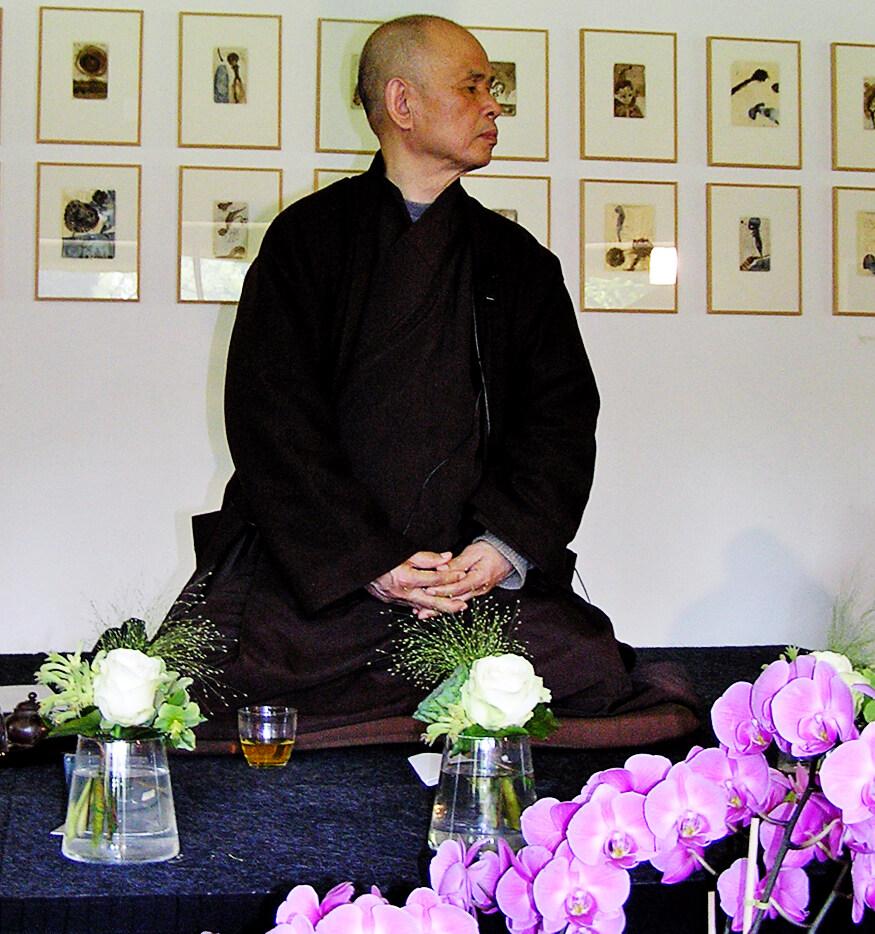
Thich Nhat Hanh.

Zen monk · Author · Peace activist

During the Vietnam War, Thích Nhất Hạnh helped train volunteers to rebuild villages. In exile, he wrote to those same workers about how to wash a dish or peel an orange with attention. Both belong to the same body of work. At Plum Village, the Vietnamese Zen teacher made that connection something people could practice together. The OPS type was supplied by the Atlas owner.

OBJECTIVE PERSONALITY CLASSIFICATIONFF-Ni/Fe-BS/P(C)What does this mean?
PERSONALITY SYSTEMObjective Personality
LEAD FUNCTIONNi · Introverted Intuition
SECOND SAVIOR FUNCTIONFe · Extroverted Feeling
MBTI EQUIVALENTINFJ
01 / BEHIND THE CLASSIFICATION

The personality behind the fame.

How does a recorded OPS classification like FF-Ni/Fe-BS/P(C) break down? Walk through nine coins and watch the proposed type take shape. These are deductions from the archived code, not independent evidence of typing accuracy.

Scroll below to see Thich Nhat Hanh take shape.

STARTING POINT512 possible OPS typesEach type combines core functions, an animal order, and sexual modalities.
THE FINISH LINEFF-Ni/Fe-BS/P(C)One recorded classification, decoded from its components.
Thich Nhat Hanh’s HUMAN NEEDS 01—03
01
DECIDER OR OBSERVER?

Observer over Decider

Observers have more balanced Decider poles in the middle: Self (Di) and Tribe (De). Their own perspective and other people's perspectives tend to be easier to navigate. Things are the harder territory. Control (Oi) and Chaos (Oe) sit at the extremes, so disrupted plans, uncertainty, and a changing world can trigger the strongest reactions.

When exile cut him off from Vietnam, Nhất Hạnh kept working for peace through a different set of circumstances. He spoke abroad, led the Buddhist delegation at the Paris peace talks, and eventually helped establish a practice community in France. An Observer lens puts the pressure on what happens when access, timing and plans are suddenly out of your hands. A steady direction can carry work across a disruption. It can also make it harder to recognize when the conditions call for a different approach.


O
02
SELF OR TRIBE?

De · Tribe over Di · Self

Tribe (De) is the stronger deciding pole. They check decisions against people, shared standards, and what works for the group: what do we need, what will others think? The strength is coordination and responsiveness; the recurring friction is the Self (Di)—knowing and defending their own position. As the portrait unfolds, notice how Tribe takes the lead.

At Plum Village, Palestinians and Israelis came to practice together, with time set aside to hear each other’s accounts. Tribe over Self brings the shared conditions for a conversation into focus. Participants need enough trust to speak and enough patience to hear an account they may dispute. The strength is making room for voices that rarely meet. The tradeoff is that protecting the conversation can make it harder to state a personal conviction that might unsettle it.

De
03
GATHER OR ORGANIZE?

Oi · Organize over Oe · Gather

Organize (Oi) leads with refining, preserving, and structuring what is already known. Its strength is preparation and clear direction; the recurring friction is unexpected change that disrupts the plan. Another layer of the personality portrait comes into focus.

The community that became Plum Village outgrew its first home, a small retreat near Paris known as Sweet Potato. The larger site gave a familiar set of practices room to grow. Organize over Gather highlights what continuity makes possible. People can learn a rhythm of walking, sitting and working together because they can return to it. The friction comes when a reliable form starts to feel indispensable. A bigger and more varied community may need to change parts of the routine that served the original group.

Oi
FIRST THREE COINSO + De + Oi

These establish the preferred human needs in the OPS framework.

Thich Nhat Hanh’s FUNCTIONS 04—05
04
FEELING OR THINKING?

Feeling · F over Thinking · T

Feeling (F) evaluates decisions through values, meaning, and what matters—not simply through emotion. Its strength is a clear sense of significance; Thinking (T) provides balance through impersonal reasons, consistency, and evidence. Combined with Tribe (De), this forms the recorded Savior Fe.

At the School of Youth for Social Service, volunteers rebuilt villages and helped set up medical stations. Fe gives the earlier Tribe preference a more specific shape. A shared value, reducing suffering, became a reason for people to take on difficult work together. That commitment can keep the human stakes in view when a decision looks purely logistical. It still leaves hard questions about which projects are feasible, which resources are scarce and how to tell whether the help is reaching the people who need it.

F → Fe
05
SENSING OR INTUITION?

Intuition · N over Sensing · S

Intuition (N) focuses on concepts, patterns, and what information might mean. Sensing (S) balances it through observable facts, physical detail, and direct experience. Combined with Organize (Oi), this gives the recorded Savior Ni.

In a teaching on interbeing, Nhất Hạnh asked listeners to look at a sheet of paper and trace it back to trees, rain and clouds. Ni makes a single object the entry point to a larger pattern. The strength is showing dependencies an ordinary glance misses. The risk is trusting a satisfying connection before checking its details. Ask where this particular sheet came from and who made it, and the physical facts might add something the broad picture leaves out.

N → Ni
THE TWO SAVIOR FUNCTIONSNi / Fe

Opposing functions: Se and Ti.

Thich Nhat Hanh’s ANIMAL STACK 06—07
06
CONSUME OR BLAST?

Blast over Consume

Consume gathers information for internal processing; Blast organizes and communicates information. The recorded order is Blast → Sleep → Play → Consume. This comparison follows their positions in that stack.

The Miracle of Mindfulness began as a letter to Brother Quang, a staff member at the school in Vietnam. Nhất Hạnh turned a body of teaching into directions a worker could try while doing the dishes. Blast first helps explain the value of making an organized idea usable at a distance. A clear instruction can travel without the teacher. It can also travel faster than the feedback that would tell the teacher where it needs to change.

B > C
07
PLAY OR SLEEP?

Sleep over Play

Play emphasizes external real-time engagement; Sleep emphasizes internal processing. The recorded stack places Sleep earlier.

Before Plum Village, Nhất Hạnh and his colleagues retreated to a farmstead outside Paris to walk in the forest, garden and rest. Sleep over live engagement brings that pause into focus. It gives experiences time to settle into something a person can make sense of before the next exchange. In this profile, that inward interval complements the clarity of Blast. The tradeoff is that a conclusion can feel settled in private before anyone else has had a chance to test it.

S > P
Thich Nhat Hanh’s ANIMAL ORIENTATION 08—09
08
INFO OR ENERGY DOMINANT?

Energy over Info

Energy dominant means Play and Sleep are both in the top three: there is access to expending energy through engagement and conserving it through internal processing. Consume last leaves the information side uneven—Blast may broadcast more than gets taken in.

In his teachings on a breathing room at home, Nhất Hạnh described how a child could ring a bell and a parent could join them. The same practice makes room for Sleep’s quiet reset and Play’s shared response. With both in the top three, this stack is Energy dominant. The information imbalance is easy to miss. A teacher can explain an exercise clearly and try it with people, then move on before asking what they actually found difficult.

Energy
09
INTROVERSION OR EXTROVERSION?

Extroversion over Introversion

The last animal, Consume, determines this OPS coin: Play or Blast last means Introversion; Consume or Sleep last means Extroversion. This describes animal orientation, not sociability or shyness.

A Zen monk can spend long stretches in silence and still land on Extroversion in this OPS coin. Consume is fourth, so the question is when fresh information gets taken in. The Palestinian and Israeli retreats show why that timing matters. A teacher can give the group a clear practice and help people use it together. Setting aside time to hear what participants say was missing gives the next retreat a chance to change in response.

E
Sexual Modalities

The four sexual modalities.

OPS uses masculine/feminine sensory and extroverted-deciding distinctions as framework-specific terms, not gender categories. The four modalities are already included in the original 512 types. The recorded modality is FF · Tester.

MM KinestheticMasculine Sensory · Masculine De
MF AudioMasculine Sensory · Feminine De
FF RECORDED MODALITYTesterFeminine Sensory · Feminine De
FM VisualFeminine Sensory · Masculine De
COMPLETE RECORDED OPS TYPE · MODALITY INCLUDEDFF-Ni/Fe-BS/P(C)

Ni leads, Fe supports, and the animal stack is Blast → Sleep → Play → Consume.

THE FINISHED PORTRAIT · ALL NINE COINS REVEALED

Thich Nhat Hanh's complete function and animal stack

BlastSleepPlayConsumemNifFemTifSe
FF-Ni/Fe-BS/P(C)DOUBLE ACTIVATED · BLASTExplore the Interactive Coin Builder →
THE THICH NHAT HANH LENS

What a practice can carry.

Nhất Hạnh is often remembered for walking slowly and speaking softly. The work behind that image was urgent. Volunteers in Vietnam helped rebuild damaged villages while he made a case for peace abroad. Later, in France, he helped build a community around practices as ordinary as walking and eating. The quiet had a job to do.

His Ni/Fe pairing offers one reading of that work. Ni looks for a thread connecting attention at the kitchen sink to the way people respond to suffering. Fe makes the connection teachable and shared. That gives a community a direction it can act on. It can also make a coherent idea feel ready before the people trying it have had their say.

As an Observer and Double Decider, the main strain in this reading is between preserving a direction and adapting when circumstances change. The middle deciding functions give personal and collective judgments more room. Neglected Se, opposite lead Ni, asks what is happening here that the larger idea has missed. Two people at the same retreat may need very different things from the same exercise.

Blast → Sleep → Play → Consume puts clear teaching, private reflection and live exchange ahead of fresh intake. With Consume last, feedback can come after the next lesson is already taking shape. A concrete counterweight would be to ask participants what failed to translate to their daily lives, then use one of those accounts to revise the next session. The teaching keeps its clarity and gets a chance to learn from the people using it.

Want to understand the Savior and Demon states behind these nine coins? Explore the complete explanation, visual examples, and typing principles on our Methodology page →

02 / KEEP EXPLORING

Different faces. Familiar patterns.

Explore other celebrities with related recorded OPS classifications. Related functions are not necessarily exact type matches.

Discover Type Twins
YOUR TURN

Curious about your own type?

Discover how your own personality might be classified through Objective Personality.

Get objectively typed
Thich Nhat Hanh's Personality Type & OPS Profile | The Personality Atlas