The Personality Atlas
THE CELEBRITY PERSONALITY ARCHIVE / THEORETICAL PHYSICS

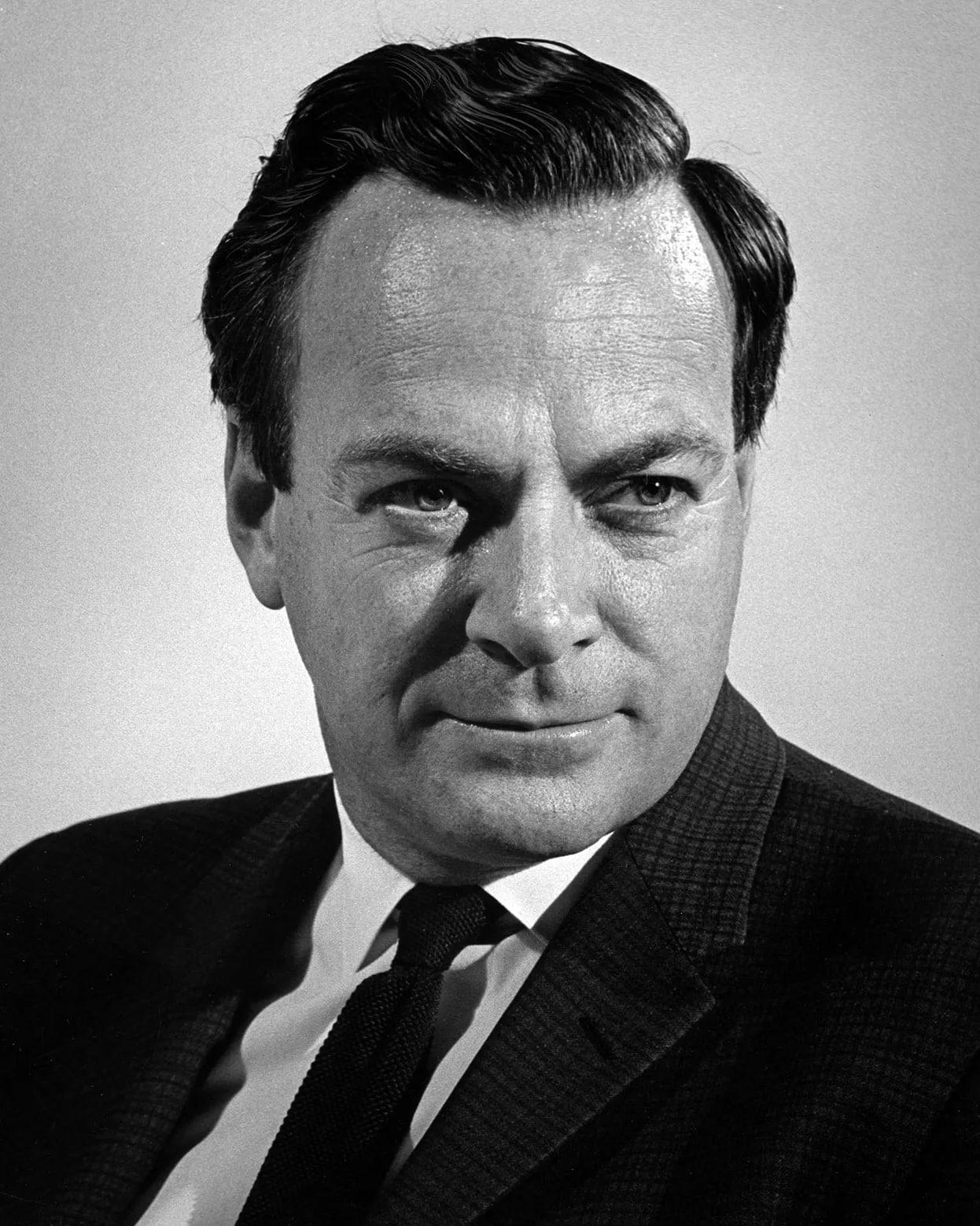
Richard Feynman.

Theoretical physicist · Nobel laureate · science popularizer

Richard Feynman became a rare kind of scientific celebrity: a Nobel-winning theorist who worked on wartime physics at Los Alamos, later helped investigate the Challenger disaster, and made abstract ideas feel electrically alive in lectures, books, and classrooms. Behind the showman was a relentless problem-hunter who trusted his own understanding enough to challenge geniuses, institutions, and elegant nonsense alike.

OBJECTIVE PERSONALITY CLASSIFICATIONMF-Ne/Ti-CP/B(S) #4What does this mean?
PERSONALITY SYSTEMObjective Personality
LEAD FUNCTIONNe · Extroverted Intuition
SECOND SAVIOR FUNCTIONTi · Introverted Thinking
MBTI EQUIVALENTENTP
01 / BEHIND THE CLASSIFICATION

The personality behind the fame.

How does a recorded OPS classification like MF-Ne/Ti-CP/B(S) #4 break down? Walk through nine coins and watch the proposed type take shape. These are deductions from the archived code, not independent evidence of typing accuracy.

Scroll below to see Richard Feynman take shape.

STARTING POINT512 possible OPS typesEach type combines core functions, an animal order, and sexual modalities.
THE FINISH LINEMF-Ne/Ti-CP/B(S) #4One recorded classification, decoded from its components.
Richard Feynman’s HUMAN NEEDS 01—03
01
DECIDER OR OBSERVER?

Observer over Decider

Observers have more balanced Decider poles in the middle: Self (Di) and Tribe (De). Their own perspective and other people's perspectives tend to be easier to navigate. Things are the harder territory. Control (Oi) and Chaos (Oe) sit at the extremes, so disrupted plans, uncertainty, and a changing world can trigger the strongest reactions.

Feynman kept landing in situations where the problem was not approval but reality refusing to cooperate. As a boy he repaired radios by figuring out what had physically gone wrong; at Oak Ridge he pushed safety procedures for enriched uranium storage because the material itself could become dangerous under the wrong conditions; later he became publicly associated with investigating why a shuttle failed. That is Observer pressure: circumstances, systems, and hidden variables. The strength is calm curiosity inside chaos. The blind spot is assuming every mess will yield if you just keep pulling it apart.
O
02
SELF OR TRIBE?

Di · Self over De · Tribe

Self (Di) is the stronger deciding pole. They check decisions against their own values or reasons first: what makes sense to me, what feels right to me? The strength is independent conviction; the recurring friction is the Tribe (De)—other people's standards, feedback, and expectations. As the portrait unfolds, notice how Self takes the lead.

When Feynman argued physics with Niels Bohr at Los Alamos, he was valuable partly because he would not defer just because Bohr was Bohr. The same independent streak shows up in his shrug toward prestige rituals, from joking about Mensa to asking rude-sounding but clarifying questions in class. Self over Tribe does not mean antisocial; it means the inner standard gets first vote. That can produce unusual honesty and original work. The cost is friction. If your personal sense of what is true outruns the room, other people may experience clarity as disrespect.

Di
03
GATHER OR ORGANIZE?

Oe · Gather over Oi · Organize

Gather (Oe) leads with new information, experiences, and possibilities. Its strength is curiosity and adaptability; the recurring friction is narrowing the options and settling into what is already known. Another layer of the personality portrait comes into focus.

Feynman’s career was almost offensively wide. He moved from math to electrical engineering to physics, then from quantum electrodynamics to superfluid helium, the parton model, early quantum computing, nanotechnology talks, and bestselling science lectures. Gather over Organize fits that appetite for the next opening better than a narrow, settled lane. New territory was not a distraction; it was fuel. The strength is range and improvisation when a fresh problem appears. The blind spot is that a life can keep expanding sideways, making it harder to live inside fixed routines, inherited methods, or one tidy long-term box.

Oe
FIRST THREE COINSO + Di + Oe

These establish the preferred human needs in the OPS framework.

Richard Feynman’s FUNCTIONS 04—05
04
FEELING OR THINKING?

Thinking · T over Feeling · F

Thinking (T) evaluates decisions through reasons, logic, and what works—not a lack of emotion. Its strength is analytical consistency; Feeling (F) provides balance through values, meaning, and the human consequences of a decision. Combined with Self (Di), this forms the recorded Savior Ti.

His signature contribution was not just solving equations but finding cleaner ways to think with them: path integrals, Feynman diagrams, and brutally clear explanations of quantum electrodynamics. That points to Ti, a thinking style that wants the model to make sense from the inside out. It is a serious advantage in theoretical physics and in teaching difficult ideas without ceremonial fog. The limit is social texture. The same mind that cuts through nonsense can also cut through people’s patience, sounding sharper or more dismissive than the moment requires.

T → Ti
05
SENSING OR INTUITION?

Intuition · N over Sensing · S

Intuition (N) focuses on concepts, patterns, and what information might mean. Sensing (S) balances it through observable facts, physical detail, and direct experience. Combined with Gather (Oe), this gives the recorded Savior Ne.

Ne shows up in how Feynman kept seeing conceptual doorways where other physicists saw walls. His doctoral insight that positrons could be treated like electrons moving backward in time is a perfect example: an imaginative reframing that opened powerful mathematics. The later lecture There’s Plenty of Room at the Bottom carried the same instinct, jumping toward possibilities not yet built. Intuition gives him reach beyond the obvious. The growth cost is that reality still demands measurements, constraints, and procedures. A brilliant possibility is not automatically the same thing as a finished, workable structure.

N → Ne
THE TWO SAVIOR FUNCTIONSNe / Ti

Opposing functions: Si and Fe.

Richard Feynman’s ANIMAL STACK 06—07
06
CONSUME OR BLAST?

Consume over Blast

Consume gathers information for internal processing; Blast organizes and communicates information. The recorded order is Consume → Play → Blast → Sleep. This comparison follows their positions in that stack.

Consume comes before Blast here, which fits how much of Feynman’s public impact rested on obsessive intake before declaration. He taught himself advanced mathematics as a teenager, devoured hard physics problems at Princeton and Los Alamos, and kept collecting mechanisms until he could explain them with unnerving simplicity. The strength is substance: when he finally spoke, there was usually real understanding underneath the performance. The blind spot is that more input can always feel useful. Research, reading, and tinkering can postpone the harder move of narrowing everything into one plain conclusion.

C > B
07
PLAY OR SLEEP?

Play over Sleep

Play emphasizes external real-time engagement; Sleep emphasizes internal processing. The recorded stack places Play earlier.

With Consume already ahead of Blast, Play also comes before Sleep. Feynman did not just learn alone; he stress-tested ideas in motion with other people, from Wheeler and Bethe to the computation groups he led and the public lectures that bounced difficult concepts off live audiences. That gives him a kinetic, collaborative edge. Real-time exchange can sharpen the insight. The cost is that quieter consolidation lands later. If interaction stays stimulating enough, there is less pressure to stop, settle, and let an experience fully organize itself before the next conversation begins.

P > S
Richard Feynman’s ANIMAL ORIENTATION 08—09
08
INFO OR ENERGY DOMINANT?

Info over Energy

Info dominant means Consume and Blast are both in the top three: gathering and communicating information are more balanced. Sleep last leaves the energy side uneven—Play can keep engagement going without enough private recovery.

Info dominance fits the Feynman most people recognize: the physicist who could absorb staggering amounts of material and then turn it into explanations that changed a field or taught generations. The Nobel work, The Feynman Lectures on Physics, and his later popular books all show that Consume and Blast are both active near the front. But the missing balance is Sleep last. He could keep learning, talking, demonstrating, and engaging while private recovery and slow internal settling received less emphasis. The strength is transmissible brilliance. The cost is running hot enough that reflection arrives after the machine is already moving.

Info
09
INTROVERSION OR EXTROVERSION?

Extroversion over Introversion

The last animal, Sleep, determines this OPS coin: Play or Blast last means Introversion; Consume or Sleep last means Extroversion. This describes animal orientation, not sociability or shyness.

Feynman’s recorded animal order ends with Sleep, which makes this OPS Extroversion even though much of his work happened alone at blackboards or desks. That coin is about the stack’s orientation, not whether someone looks socially busy. His pattern keeps leaning outward after taking in information: test it with people, teach it, argue it, put it to use. You can see that arc from wartime labs to Caltech lectures to high-profile public investigations. The blind spot is underweighting stillness. Growth looks less like becoming quieter and more like deliberately building time to digest before the next irresistible problem.

E
Sexual Modalities

The four sexual modalities.

OPS uses masculine/feminine sensory and extroverted-deciding distinctions as framework-specific terms, not gender categories. The four modalities are already included in the original 512 types. The recorded modality is MF · Audio.

MM KinestheticMasculine Sensory · Masculine De
MF RECORDED MODALITYAudioMasculine Sensory · Feminine De
FF TesterFeminine Sensory · Feminine De
FM VisualFeminine Sensory · Masculine De
ADDITIONAL LAYER · SOCIAL TYPE

The four social types.

Social types are an additional layer on top of the original Objective Personality classification, introduced later in OPS research. They describe two proposed social preference coins: Flex vs. Friends and Generalize vs. Specialize. The combination and priority of these preferences produce four social types. Richard Feynman's recorded social type is #4.

SOCIAL #1 #1Flex · Generalize
SOCIAL #2 #2Generalize · Friends
SOCIAL #3 #3Specialize · Flex
SOCIAL #4 RECORDED SOCIAL TYPE#4Friends · Specialize
COMPLETE RECORDED OPS TYPE · MODALITY INCLUDED + SOCIAL TYPEMF-Ne/Ti-CP/B(S) #4

Ne leads, Ti supports, and the animal stack is Consume → Play → Blast → Sleep.

THE FINISHED PORTRAIT · ALL NINE COINS REVEALED

Richard Feynman's complete function and animal stack

ConsumePlayBlastSleepfNemTifFemSi
MF-Ne/Ti-CP/B(S) #4DOUBLE ACTIVATED · PLAYExplore the Interactive Coin Builder →
THE RICHARD FEYNMAN LENS

The showman who kept chasing the mechanism.

Feynman’s public image can shrink him into a grin, a bongo, or the swaggering professor who made hard science sound easy. But the career underneath that impression was built in rooms where reality punished sloppiness: Los Alamos calculations, Oak Ridge safety problems, and later the national scrutiny of the Challenger investigation. The performer was real. So was the mechanic hunting the hidden failure inside the system.

His Ne/Ti savior pairing explains why his work could feel both playful and merciless. Ne keeps opening alternative models, while Ti refuses to keep one just because it is famous, traditional, or socially protected. That combination helped produce path integrals, diagrams, and lectures that made strange physics graspable. The limit is impatience with slower consensus-building, because a cleaner model can outrun the room still trying to test and trust it.

As an Observer and Double Decider, Feynman is more fundamentally thrown by stubborn systems than by ordinary people drama, even if his bluntness created friction. That pairing gives broader range with judgments and relationships than with uncertainty and physical conditions that still refuse to line up. The neglected function opposite his lead savior is Si: precedent, maintenance, and settled facts that keep brilliance from improvising past the basics.

Consume → Play → Blast → Sleep puts the pressure point in plain view. He first takes in, then tests with people, then teaches, while Sleep last creates the OPS Extroversion tilt toward staying in motion with information. The balance is not muting his curiosity or public clarity. It is pausing after a breakthrough or lecture to write the settled summary before chasing the next mechanism.

Want to understand the Savior and Demon states behind these nine coins? Explore the complete explanation, visual examples, and typing principles on our Methodology page →

02 / KEEP EXPLORING

Different faces. Familiar patterns.

Explore other celebrities with related recorded OPS classifications. Related functions are not necessarily exact type matches.

Discover Type Twins
YOUR TURN

Curious about your own type?

Discover how your own personality might be classified through Objective Personality.

Get objectively typed
Richard Feynman's Personality Type & OPS Profile | The Personality Atlas