The Personality Atlas
THE CELEBRITY PERSONALITY ARCHIVE / POLITICS

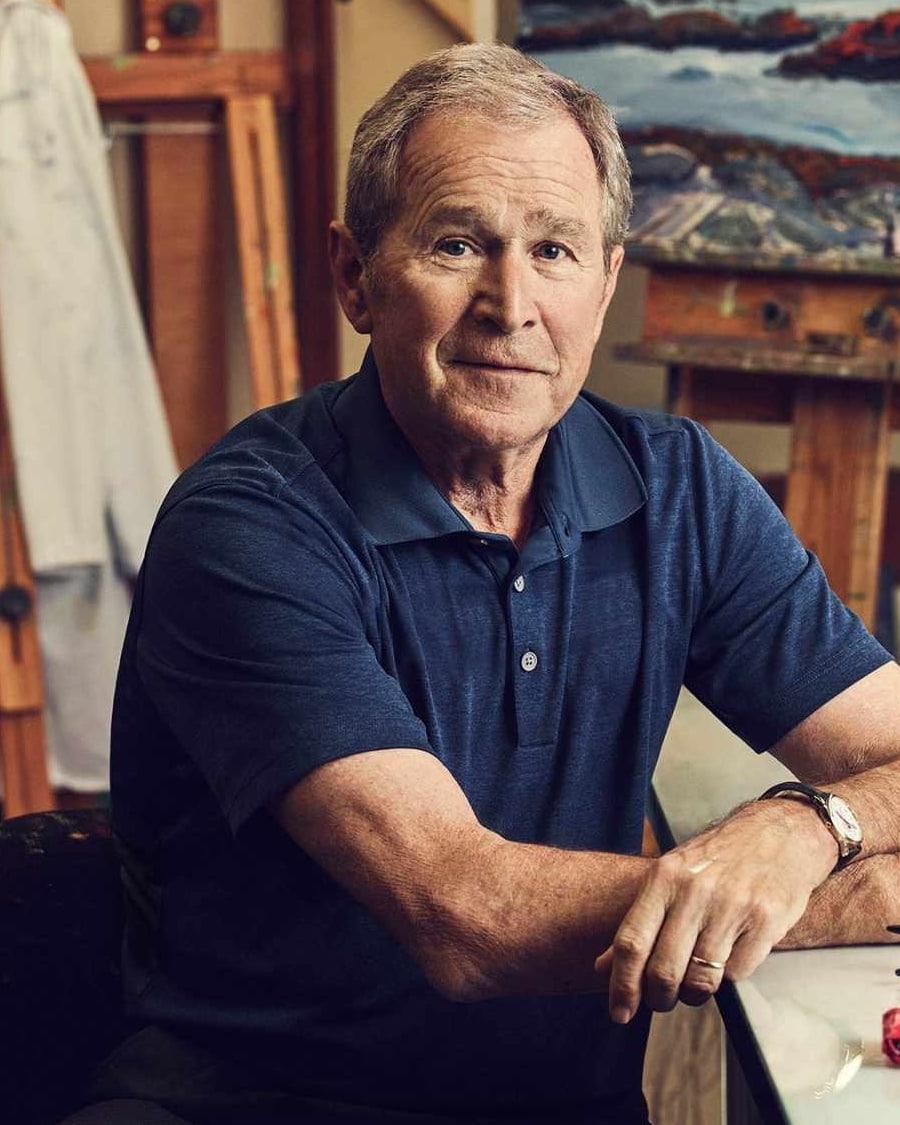
George W. Bush.

43rd U.S. President · Former Texas Governor

George W. Bush moved from Yale and Harvard Business School to oil, the Texas Rangers, the Texas governorship, and finally the White House, where a disputed 2000 election, the bullhorn days after September 11, wars abroad, education reform, and a bruising 2008 exit made him one of the most argued-over presidents of his era.

OBJECTIVE PERSONALITY CLASSIFICATIONFF-Te/Si-BP/C(S)What does this mean?
PERSONALITY SYSTEMObjective Personality
LEAD FUNCTIONTe · Extroverted Thinking
SECOND SAVIOR FUNCTIONSi · Introverted Sensing
MBTI EQUIVALENTESTJ
01 / BEHIND THE CLASSIFICATION

The personality behind the fame.

How does a recorded OPS classification like FF-Te/Si-BP/C(S) break down? Walk through nine coins and watch the proposed type take shape. These are deductions from the archived code, not independent evidence of typing accuracy.

Scroll below to see George W. Bush take shape.

STARTING POINT512 possible OPS typesEach type combines core functions, an animal order, and sexual modalities.
THE FINISH LINEFF-Te/Si-BP/C(S)One recorded classification, decoded from its components.
George W. Bush’s HUMAN NEEDS 01—03
01
DECIDER OR OBSERVER?

Decider over Observer

Deciders have more balanced Observer poles in the middle: Control (Oi) and Chaos (Oe). Organizing what's known and handling what's new tend to feel more manageable. People are the harder territory. Self (Di) and Tribe (De) sit at the extremes, so judgment, rejection, approval, and conflict can trigger the strongest reactions.

The defining pressure in Bush’s public life is people, not uncertainty. The 2000 election ended in a month of recounts and Bush v. Gore, then his presidency swung from record approval after September 11 to deep unpopularity by the 2008 financial crisis. That is Decider terrain: legitimacy, loyalty, judgment, and whether the country is with you or against you. His strength was functioning under relentless approval whiplash and still making moves. The blind spot is that surviving judgment can harden into a style that treats opposition as one more hurdle to push through rather than feedback to metabolize.
D
02
SELF OR TRIBE?

De · Tribe over Di · Self

Tribe (De) is the stronger deciding pole. They check decisions against people, shared standards, and what works for the group: what do we need, what will others think? The strength is coordination and responsiveness; the recurring friction is the Self (Di)—knowing and defending their own position. As the portrait unfolds, notice how Tribe takes the lead.

Bush’s style repeatedly leans toward the tribe standard: organize the room, sell the case, get people moving together. As president he held town hall meetings around the country to build support for his tax-cut plan, and as governor he worked a message simple enough to win broad margins in 1994 and a record 68 percent in 1998. That outward decisiveness is useful when legislation needs momentum. The cost is that agreement inside the team can start to feel like proof itself. Dissent then arrives not as useful friction, but as an obstacle to the plan already being rallied.

De
03
GATHER OR ORGANIZE?

Oi · Organize over Oe · Gather

Organize (Oi) leads with refining, preserving, and structuring what is already known. Its strength is preparation and clear direction; the recurring friction is unexpected change that disrupts the plan. Another layer of the personality portrait comes into focus.

Bush’s public record is full of organizing moves: a gubernatorial campaign built around four recurring themes, higher standards for schools, tort reform, crime reduction, and later a presidency that translated priorities into named programs and institutions. Organize-first is good at reducing noise into an agenda people can remember. It helps explain why he could keep repeating a few central commitments until they became policy. The tradeoff is rigidity. When a leader narrows the map early, new evidence or competing possibilities can be granted less weight than the already chosen frame.

Oi
FIRST THREE COINSD + De + Oi

These establish the preferred human needs in the OPS framework.

George W. Bush’s FUNCTIONS 04—05
04
FEELING OR THINKING?

Thinking · T over Feeling · F

Thinking (T) evaluates decisions through reasons, logic, and what works—not a lack of emotion. Its strength is analytical consistency; Feeling (F) provides balance through values, meaning, and the human consequences of a decision. Combined with Tribe (De), this forms the recorded Savior Te.

Te shows up in Bush’s preference for visible systems and executable policy. No Child Left Behind turned education into standards and accountability; the Department of Homeland Security turned a shattered security landscape into a formal structure; Medicare Part D added a major program through legislation rather than rhetoric alone. The strength here is practical coordination: make the machine move, name the objective, assign responsibility. The blind spot is that efficient structure can look complete before the human argument is complete. A policy can be implemented on paper while trust, nuance, or unintended consequences remain unresolved.

T → Te
05
SENSING OR INTUITION?

Sensing · S over Intuition · N

Sensing (S) focuses on concrete details, observable reality, and lived experience. Intuition (N) balances it by looking for broader patterns, concepts, and implications. Combined with Organize (Oi), this gives the recorded Savior Si.

Si fits Bush’s reliance on record, precedent, and the persuasive power of the familiar. In the 2000 campaign he repeatedly sold his experience as Texas governor, and that governorship itself emphasized concrete standards, teacher pay, criminal-justice reforms, and a renewable-energy requirement that later helped make Texas a wind leader. This is Sensing at its most politically useful: point to what was done, not just what might be imagined. The cost is that a proven script can become a comfort blanket. Familiar benchmarks do not automatically prepare a presidency for a radically altered landscape.

S → Si
THE TWO SAVIOR FUNCTIONSTe / Si

Opposing functions: Fi and Ne.

George W. Bush’s ANIMAL STACK 06—07
06
CONSUME OR BLAST?

Blast over Consume

Consume gathers information for internal processing; Blast organizes and communicates information. The recorded order is Blast → Play → Consume → Sleep. This comparison follows their positions in that stack.

Blast clearly arrives earlier than Consume in Bush’s public life. He did not hide behind complexity in order to avoid a conclusion: he campaigned on “compassionate conservative,” repeated four headline themes in Texas, and then took his tax-cut pitch on the road through town halls rather than waiting for every objection to be settled first. That is the strength of Blast—direction, compression, usable messaging. The cost is predictable. When Blast leads and Consume comes later, a leader can move the room before fully widening the intake, making decisive communication easier than sustained re-examination.

B > C
07
PLAY OR SLEEP?

Play over Sleep

Play emphasizes external real-time engagement; Sleep emphasizes internal processing. The recorded stack places Play earlier.

After that outward message-setting, Bush’s next move was often interactive rather than solitary. Play comes earlier than Sleep: he worked as a campaign liaison to the media for his father, campaigned across the country, built support inside the Republican Party, and as Texas Rangers managing general partner regularly put himself in the middle of live environments instead of hovering above them. The advantage is momentum through contact. He can test a line, rally allies, and keep action moving. The cost is that private consolidation comes later. Constant engagement can outrun the slower work of stepping back and revising.

P > S
George W. Bush’s ANIMAL ORIENTATION 08—09
08
INFO OR ENERGY DOMINANT?

Info over Energy

Info dominant means Consume and Blast are both in the top three: gathering and communicating information are more balanced. Sleep last leaves the energy side uneven—Play can keep engagement going without enough private recovery.

Bush’s stack records an Info emphasis, and the biography gives plenty of public evidence for it. He could absorb institutional material—business, baseball ownership, governorship, federal policy briefings—and then turn it into programs, speeches, or legislation: tax cuts, No Child Left Behind, PEPFAR, Medicare Part D, and eventually emergency measures during the 2008 financial crisis. That cycle of taking in information and pushing it outward is a real strength. The missing balance is Sleep last. When output and action stay hot, quieter internal regrouping can become the part that gets postponed until events force a pause.

Info
09
INTROVERSION OR EXTROVERSION?

Extroversion over Introversion

The last animal, Sleep, determines this OPS coin: Play or Blast last means Introversion; Consume or Sleep last means Extroversion. This describes animal orientation, not sociability or shyness.

Sleep sits last, which makes this OPS Extroversion—not because Bush looked socially outgoing, but because the type prioritizes outward engagement over prolonged private processing. The public record fits that emphasis: campaigning, town halls, crisis-era addresses, and a presidency shaped by constant external demands long before his later low-profile retirement in Texas. The strength is staying oriented to the shared field—what must be said, coordinated, or decided next. The blind spot is subtler than shyness or boldness. When Sleep is fourth, reflection can arrive after the rollout, leaving the inner audit to catch up with a life already in motion.

E
Sexual Modalities

The four sexual modalities.

OPS uses masculine/feminine sensory and extroverted-deciding distinctions as framework-specific terms, not gender categories. The four modalities are already included in the original 512 types. The recorded modality is FF · Tester.

MM KinestheticMasculine Sensory · Masculine De
MF AudioMasculine Sensory · Feminine De
FF RECORDED MODALITYTesterFeminine Sensory · Feminine De
FM VisualFeminine Sensory · Masculine De
COMPLETE RECORDED OPS TYPE · MODALITY INCLUDEDFF-Te/Si-BP/C(S)

Te leads, Si supports, and the animal stack is Blast → Play → Consume → Sleep.

THE FINISHED PORTRAIT · ALL NINE COINS REVEALED

George W. Bush's complete function and animal stack

BlastPlayConsumeSleepfTefSimNemFi
FF-Te/Si-BP/C(S)DOUBLE ACTIVATED · PLAYExplore the Interactive Coin Builder →
THE GEORGE W. BUSH LENS

The campaign voice and the private lag

That image of Bush with a bullhorn at Ground Zero flattened him into a symbol: the plainspoken wartime president, steady enough to sound certain when the country wanted certainty. But he had spent years rehearsing that public clarity through baseball ownership, Texas campaigning, and a habit of putting a few headline themes above a messier reality.

His Te/Si pairing is built for turning a message into structure. Bush could move tax cuts, school standards, Homeland Security, and Medicare Part D through institutions instead of leaving them as applause lines. That is the strength: executable leadership anchored in record and precedent. The limit is sticking with the chosen frame after conditions around it have changed.

As a Decider and Double Observer, Bush handles people-pressure first while carrying more flexibility with information than with inner value calibration. That can look commanding: sort the alliances, keep the coalition moving, make the call. But the human-needs imbalance lands around identity and conscience. The neglected function opposite his lead savior is Fi, so personal-value checking can get less airtime than leading the room.

Blast → Play → Consume → Sleep gives him a fast outer loop: state the direction, work it with people, gather more as needed, and leave the deepest private reset for last. That imbalance does not cancel his strengths; it explains the lag between action and self-audit. The balancing move is deliberate quiet review before the next rollout—slowing just enough to test consequences carefully without losing the capacity to lead.

Want to understand the Savior and Demon states behind these nine coins? Explore the complete explanation, visual examples, and typing principles on our Methodology page →

02 / KEEP EXPLORING

Different faces. Familiar patterns.

Explore other celebrities with related recorded OPS classifications. Related functions are not necessarily exact type matches.

Discover Type Twins
YOUR TURN

Curious about your own type?

Discover how your own personality might be classified through Objective Personality.

Get objectively typed
George W. Bush's Personality Type & OPS Profile | The Personality Atlas