The Personality Atlas
THE CELEBRITY PERSONALITY ARCHIVE / BUSINESS

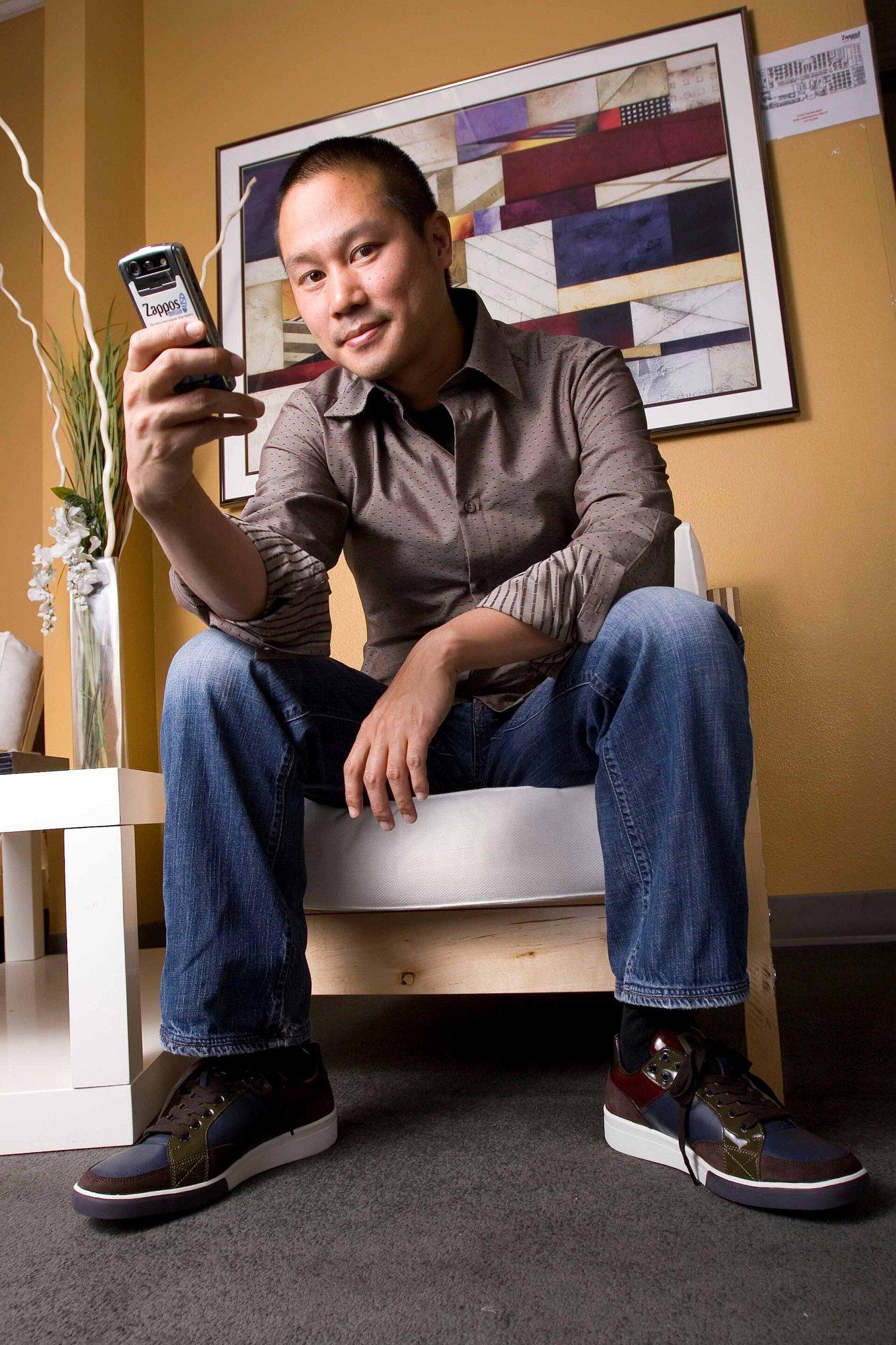
Tony Hsieh.

Entrepreneur · Investor · Author

Tony Hsieh did not just sell shoes online; he built an argument that customer service, company culture and even urban redevelopment could be designed on purpose. From LinkExchange to Zappos to downtown Las Vegas, he kept turning abstract systems into lived experiences people could step inside.

OBJECTIVE PERSONALITY CLASSIFICATIONFF-Ni/Fe-BS/C(P)What does this mean?
PERSONALITY SYSTEMObjective Personality
LEAD FUNCTIONNi · Introverted Intuition
SECOND SAVIOR FUNCTIONFe · Extroverted Feeling
MBTI EQUIVALENTINFJ
01 / BEHIND THE CLASSIFICATION

The personality behind the fame.

How does a recorded OPS classification like FF-Ni/Fe-BS/C(P) break down? Walk through nine coins and watch the proposed type take shape. These are deductions from the archived code, not independent evidence of typing accuracy.

Scroll below to see Tony Hsieh take shape.

STARTING POINT512 possible OPS typesEach type combines core functions, an animal order, and sexual modalities.
THE FINISH LINEFF-Ni/Fe-BS/C(P)One recorded classification, decoded from its components.
Tony Hsieh’s HUMAN NEEDS 01—03
01
DECIDER OR OBSERVER?

Observer over Decider

Observers have more balanced Decider poles in the middle: Self (Di) and Tribe (De). Their own perspective and other people's perspectives tend to be easier to navigate. Things are the harder territory. Control (Oi) and Chaos (Oe) sit at the extremes, so disrupted plans, uncertainty, and a changing world can trigger the strongest reactions.

At Zappos, the obvious obstacle was not whether Tony Hsieh deserved attention; it was whether customers would trust buying shoes online at all. Free shipping and free returns turned a strange internet bet into a workable system for people nervous about fit and hassle. Earlier, LinkExchange solved another circumstance problem by giving websites a scalable way to trade banner space. That is Observer pressure: the bottleneck sits in the setup, the market and the unknowns. His strength was redesigning conditions. The blind spot is treating environmental fixes as the answer to every problem.
O
02
SELF OR TRIBE?

De · Tribe over Di · Self

Tribe (De) is the stronger deciding pole. They check decisions against people, shared standards, and what works for the group: what do we need, what will others think? The strength is coordination and responsiveness; the recurring friction is the Self (Di)—knowing and defending their own position. As the portrait unfolds, notice how Tribe takes the lead.

Hsieh became famous not only for revenue but for making culture a public operating principle. Zappos was repeatedly listed among Fortune’s best companies to work for, hired only about 1% of applicants, and later experimented with holacracy because he believed employees could self-organize. That leans Tribe over Self: calibrating toward morale, customer experience and collective buy-in. The strength is a company identity people can actually feel. The cost is that shared ideals can become so important that personal limits, dissent or less flattering feedback arrives late.

De
03
GATHER OR ORGANIZE?

Oi · Organize over Oe · Gather

Organize (Oi) leads with refining, preserving, and structuring what is already known. Its strength is preparation and clear direction; the recurring friction is unexpected change that disrupts the plan. Another layer of the personality portrait comes into focus.

He almost deleted Nick Swinmurn’s voicemail, then locked onto one strategic pattern: footwear was a huge market, and some of it was already being sold remotely through catalogs. Once that line of sight appeared, Hsieh committed hard—joining Zappos as CEO, scaling it from $1.6 million in sales in 2000 to $1 billion by 2009, then extending his focus into downtown Las Vegas. Organize over Gather prefers a through-line over endless options. The payoff is coherence. The blind spot is staying loyal to a blueprint after reality has started asking for revisions.

Oi
FIRST THREE COINSO + De + Oi

These establish the preferred human needs in the OPS framework.

Tony Hsieh’s FUNCTIONS 04—05
04
FEELING OR THINKING?

Feeling · F over Thinking · T

Feeling (F) evaluates decisions through values, meaning, and what matters—not simply through emotion. Its strength is a clear sense of significance; Thinking (T) provides balance through impersonal reasons, consistency, and evidence. Combined with Tribe (De), this forms the recorded Savior Fe.

Hsieh’s book was called Delivering Happiness, which is almost aggressively on-brand for a Feeling-first decider. He treated customer service, workplace atmosphere and even downtown spaces as value-laden experiences, not just transactions. That helped make Zappos memorable in a crowded retail field: customers were not only buying shoes, they were buying trust and a tone. Feeling’s strength is recognizing that morale and meaning move behavior. Its void is that an inspiring values story can outrun hard constraints, asking people to carry an emotional vision without equally clear limits.

F → Fe
05
SENSING OR INTUITION?

Intuition · N over Sensing · S

Intuition (N) focuses on concepts, patterns, and what information might mean. Sensing (S) balances it through observable facts, physical detail, and direct experience. Combined with Organize (Oi), this gives the recorded Savior Ni.

Before online retail became ordinary, Hsieh could spot the implication inside a single market clue: if Americans already bought footwear through mail-order catalogs, then buying shoes without a store visit was not absurd, only underbuilt. The same pattern-sense appeared in the Downtown Project, which grew from housing Zappos employees into a broader attempt to seed an entrepreneurial district. Intuition is powerful when it sees the trajectory before the crowd does. The cost is that the future pattern can feel more persuasive than immediate friction, infrastructure and timing.

N → Ni
THE TWO SAVIOR FUNCTIONSNi / Fe

Opposing functions: Se and Ti.

Tony Hsieh’s ANIMAL STACK 06—07
06
CONSUME OR BLAST?

Blast over Consume

Consume gathers information for internal processing; Blast organizes and communicates information. The recorded order is Blast → Sleep → Consume → Play. This comparison follows their positions in that stack.

Hsieh’s career repeatedly favored Blast over Consume. LinkExchange found its first 30 clients through direct emails to webmasters, and later Hsieh turned Zappos culture into a crisp public message through speeches and Delivering Happiness. The advantage is obvious: he could take a concept and make it communicable fast enough for other people to act on it. The shadow sits on the other side of the comparison. When Blast comes earlier than Consume, a clean message can get ahead of fresh intake, leaving less room for inconvenient data to reshape the pitch.

B > C
07
PLAY OR SLEEP?

Sleep over Play

Play emphasizes external real-time engagement; Sleep emphasizes internal processing. The recorded stack places Sleep earlier.

With Blast already outranking Consume, the next revealing contrast is Sleep over Play. Hsieh did not just energize rooms; he kept returning to internally processed models for how a company or a neighborhood should work, from Zappos’s structure to the Downtown Project’s live-work vision. Sleep brings conviction, refinement and a stable inner map. Its cost is slower adaptation in messy real-time exchange. When Sleep lands earlier than Play, a person may trust the processed vision so much that spontaneous pushback from the outside world registers as noise instead of necessary friction.

S > P
Tony Hsieh’s ANIMAL ORIENTATION 08—09
08
INFO OR ENERGY DOMINANT?

Info over Energy

Info dominant means Consume and Blast are both in the top three: gathering and communicating information are more balanced. Play last leaves the energy side uneven—Sleep can conserve energy without enough spontaneous outward engagement.

Hsieh’s stack is Info-dominant: the top three animals keep circling information—framing it, refining it, then gathering more—before the last-animal gap shows up in live interaction. That fits a public life spent building systems people could understand, from banner-ad exchanges to Zappos policies to a bestselling business memoir. His strength was turning ideas into usable narratives. The missing balance is Play last. He could explain a model and believe in people, yet still underweight the unpredictable, unscripted back-and-forth that tests whether a system works outside the plan.

Info
09
INTROVERSION OR EXTROVERSION?

Introversion over Extroversion

The last animal, Play, determines this OPS coin: Play or Blast last means Introversion; Consume or Sleep last means Extroversion. This describes animal orientation, not sociability or shyness.

Tony Hsieh could be highly social in business and still land on the OPS Introversion coin. The reason is structural, not temperamental: Play comes last, after a stack better suited to vision, internal processing and message-setting than to constant real-time adjustment. Zappos’s public warmth and his visible Las Vegas projects do not cancel that pattern. The strength is maintaining a coherent direction instead of being blown around by every interaction. The blind spot is waiting too long to let unscripted feedback reshape the plan before it has already hardened into identity.

I
Sexual Modalities

The four sexual modalities.

OPS uses masculine/feminine sensory and extroverted-deciding distinctions as framework-specific terms, not gender categories. The four modalities are already included in the original 512 types. The recorded modality is FF · Tester.

MM KinestheticMasculine Sensory · Masculine De
MF AudioMasculine Sensory · Feminine De
FF RECORDED MODALITYTesterFeminine Sensory · Feminine De
FM VisualFeminine Sensory · Masculine De
COMPLETE RECORDED OPS TYPE · MODALITY INCLUDEDFF-Ni/Fe-BS/C(P)

Ni leads, Fe supports, and the animal stack is Blast → Sleep → Consume → Play.

THE FINISHED PORTRAIT · ALL NINE COINS REVEALED

Tony Hsieh's complete function and animal stack

BlastSleepConsumePlaymNifFemTifSe
FF-Ni/Fe-BS/C(P)DOUBLE ACTIVATED · SLEEPExplore the Interactive Coin Builder →
THE TONY HSIEH LENS

The happiness architecture had limits.

Free shipping and free returns sound like retail perks, but at Zappos they were part of Tony Hsieh’s deeper project: remove the friction that kept strangers from trusting an online shoe store. The cheerful brand hid a systems-builder who kept asking how environment, incentives and design could change behavior at scale.

His Ni/Fe pairing gave him a rare business gift. Ni could spot a long-range pattern—catalog shoe sales implying online potential, or a headquarters becoming the seed of a neighborhood—while Fe translated that vision into culture, service and belonging. The limit is that an elegant shared vision can become persuasive before every practical strain has been fully absorbed.

As an Observer and Double Decider, Hsieh’s recurring imbalance points more toward control, uncertainty and setup than toward endless people-versus-self turmoil. The human temptation is to keep optimizing the system so the human problem disappears. Neglected Se is the missing counterweight: the immediate facts on the ground, the unglamorous evidence that does not automatically fit the forecast.

Blast → Sleep → Consume → Play explains both the power and the risk. He could articulate a vision, refine it privately and keep feeding it with more information, while spontaneous real-time interaction stayed last. Balance would not mean abandoning vision; it would mean building regular, unscripted reality checks with frontline employees and local stakeholders before the next grand design locks in.

Want to understand the Savior and Demon states behind these nine coins? Explore the complete explanation, visual examples, and typing principles on our Methodology page →

02 / KEEP EXPLORING

Different faces. Familiar patterns.

Explore other celebrities with related recorded OPS classifications. Related functions are not necessarily exact type matches.

Discover Type Twins
YOUR TURN

Curious about your own type?

Discover how your own personality might be classified through Objective Personality.

Get objectively typed
Tony Hsieh's Personality Type & OPS Profile | The Personality Atlas