The Personality Atlas
THE CELEBRITY PERSONALITY ARCHIVE / SCIENCE & INDUSTRY

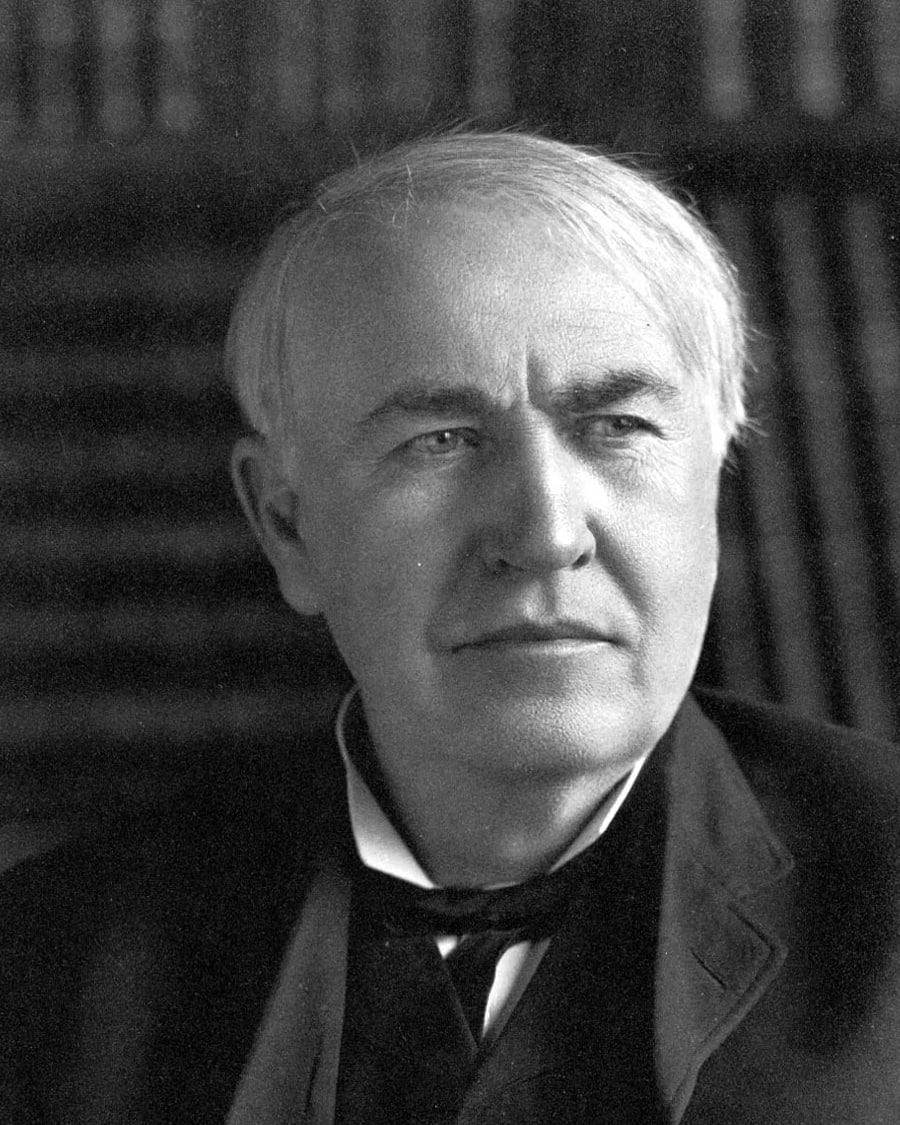
Thomas Edison.

Inventor · Industrial researcher · Business founder

Thomas Edison did not just invent devices; he staged them, financed them, litigated them, and built the machinery to force them into public life. From the phonograph and the “Village of Light” at Menlo Park to the companies that fed General Electric, he looked less like a lone genius than a prototype of the modern industrial operator—part inventor, part promoter, part human bulldozer.

OBJECTIVE PERSONALITY CLASSIFICATIONFF-Te/Ne-PC/B(S)What does this mean?
PERSONALITY SYSTEMObjective Personality
LEAD FUNCTIONTe · Extroverted Thinking
SECOND SAVIOR FUNCTIONNe · Extroverted Intuition
MBTI EQUIVALENTESTJ
01 / BEHIND THE CLASSIFICATION

The personality behind the fame.

How does a recorded OPS classification like FF-Te/Ne-PC/B(S) break down? Walk through nine coins and watch the proposed type take shape. These are deductions from the archived code, not independent evidence of typing accuracy.

Scroll below to see Thomas Edison take shape.

STARTING POINT512 possible OPS typesEach type combines core functions, an animal order, and sexual modalities.
THE FINISH LINEFF-Te/Ne-PC/B(S)One recorded classification, decoded from its components.
Thomas Edison’s HUMAN NEEDS 01—03
01
DECIDER OR OBSERVER?

Decider over Observer

Deciders have more balanced Observer poles in the middle: Control (Oi) and Chaos (Oe). Organizing what's known and handling what's new tend to feel more manageable. People are the harder territory. Self (Di) and Tribe (De) sit at the extremes, so judgment, rejection, approval, and conflict can trigger the strongest reactions.

Edison’s public life was crowded with people problems as much as invention problems: investors to persuade, employees to drive, rivals to outmaneuver, reporters to manage, and family relationships he often neglected. That points to Decider friction, where the recurring pressure is significance, loyalty, and who gets considered in the push for results. The strength is ruthless momentum through interpersonal noise; he could keep building while others stalled in politics. The blind spot is obvious in the record too: people can become instruments, and the machine keeps moving long after trust, rest, or family connection has been spent.

D
02
SELF OR TRIBE?

De · Tribe over Di · Self

Tribe (De) is the stronger deciding pole. They check decisions against people, shared standards, and what works for the group: what do we need, what will others think? The strength is coordination and responsiveness; the recurring friction is the Self (Di)—knowing and defending their own position. As the portrait unfolds, notice how Tribe takes the lead.

Tribe over Self shows up in how often Edison converted invention into other people’s buy-in. He courted Western Union, J.P. Morgan interests, Vanderbilt money, journalists, and public demonstrations, because a workable idea was not enough until the market, the press, and investors could all be moved with it. That is a real strength: he could translate technical work into collective action. The cost is living by the external scoreboard. When the tribe’s standards dominate, relationships, employees, and even children can start getting treated as secondary to the larger public project.

De
03
GATHER OR ORGANIZE?

Oe · Gather over Oi · Organize

Gather (Oe) leads with new information, experiences, and possibilities. Its strength is curiosity and adaptability; the recurring friction is narrowing the options and settling into what is already known. Another layer of the personality portrait comes into focus.

Gather over Organize fits the young telegrapher who moved through jobs and cities, learned by books and tinkering, then kept branching from telegraphy to sound recording, electric lighting, movies, batteries, cement, and rubber. Edison’s advantage was not guarding one settled lane; it was spotting another opening and pulling in more variables, materials, and experiments. The growth cost is selectivity. A mind built to keep opening options can also chase too many fronts, as the unprofitable mining venture showed. More possibilities feel productive, but they do not automatically decide which bet deserves the decade.

Oe
FIRST THREE COINSD + De + Oe

These establish the preferred human needs in the OPS framework.

Thomas Edison’s FUNCTIONS 04—05
04
FEELING OR THINKING?

Thinking · T over Feeling · F

Thinking (T) evaluates decisions through reasons, logic, and what works—not a lack of emotion. Its strength is analytical consistency; Feeling (F) provides balance through values, meaning, and the human consequences of a decision. Combined with Tribe (De), this forms the recorded Savior Te.

Thinking is unmistakable in Edison’s obsession with output, metrics, and utility. He strictly regulated employee productivity, pushed laboratory schedules to extremes, and even devised a zinc-based meter so electrical use could be measured and billed. Te is excellent at turning ideas into systems that other people can actually run. That strength helped move the light bulb from novelty to infrastructure. Its blind spot is how easily human texture gets flattened by the standard of results. The same efficiency that built factories and grids could also justify exhausting staff, controlling artists, or overlooking what the method cost other people.

T → Te
05
SENSING OR INTUITION?

Intuition · N over Sensing · S

Intuition (N) focuses on concepts, patterns, and what information might mean. Sensing (S) balances it through observable facts, physical detail, and direct experience. Combined with Gather (Oe), this gives the recorded Savior Ne.

Intuition shows in how rarely Edison stopped at the isolated gadget. He imagined recorded messages becoming the phonograph, treated electric light as a whole distribution network rather than a single bulb, and kept chasing what an invention could become at scale. Ne excels at connecting one breakthrough to a wider commercial future. That gave Edison range far beyond bench science. The tradeoff is that conceptual expansion can outrun grounded follow-through. Talking dolls, mining, and other side pursuits show how a big promising idea can absorb years before reality decides whether the vision was brilliant, premature, or just expensive.

N → Ne
THE TWO SAVIOR FUNCTIONSTe / Ne

Opposing functions: Fi and Si. This is a jumper classification.

Thomas Edison’s ANIMAL STACK 06—07
06
PLAY OR SLEEP?

Play over Sleep

Play emphasizes external real-time engagement; Sleep emphasizes internal processing. The recorded stack places Play earlier.

Play comes earlier than Sleep, and Edison’s career is almost noisy with that preference. He learned through live tinkering with operators, built labs around active collaboration, demonstrated the phonograph publicly, and turned Menlo Park into a place where ideas were tested in motion rather than protected in silence. The strength is speed through engagement: work gets sharper when people, tools, and feedback are all in the room. The blind spot is the bill that arrives later. When Play outruns Sleep, interaction keeps winning over recovery and private consolidation, and exhaustion starts masquerading as proof of seriousness.

P > S
07
CONSUME OR BLAST?

Consume over Blast

Consume gathers information for internal processing; Blast organizes and communicates information. The recorded order is Play → Consume → Blast → Sleep. This comparison follows their positions in that stack.

After that outward push, Consume arrives earlier than Blast. Edison read constantly, stocked Menlo Park with “almost every conceivable material,” enrolled in chemistry at Cooper Union, and ran endless filament tests before landing on better results. That earlier Consume gave depth to the inventions; he was not just selling slogans. But because Blast comes later, cleanly packaging the lesson can lag behind the appetite to keep taking in, testing, and controlling more data. The phonograph’s long road to commercial success shows the cost: more refinement can strengthen the product while still postponing the simplest, clearest delivery of it.

C > B
Thomas Edison’s ANIMAL ORIENTATION 08—09
08
INFO OR ENERGY DOMINANT?

Info over Energy

Info dominant means Consume and Blast are both in the top three: gathering and communicating information are more balanced. Sleep last leaves the energy side uneven—Play can keep engagement going without enough private recovery.

Edison is Info-dominant because Play, Consume, and Blast all arrive before Sleep. Publicly, that looks like a rare ability to move information through every stage: gather materials, test with people, then broadcast a vision large enough to attract capital and reshape cities. Menlo Park, the “Village of Light,” and his relentless publicity all fit that balance. The missing piece is Sleep last. He and his staff were driven to the edge of exhaustion, and he kept adding companies and campaigns rather than stepping back. The growth cost is not ignorance; it is insufficient internal recovery before the next big push.

Info
09
INTROVERSION OR EXTROVERSION?

Extroversion over Introversion

The last animal, Sleep, determines this OPS coin: Play or Blast last means Introversion; Consume or Sleep last means Extroversion. This describes animal orientation, not sociability or shyness.

Sleep last makes the OPS result Extroversion, even though that does not mean “party person.” In Play → Consume → Blast → Sleep, Edison moves more naturally toward external engagement, input, and delivery than toward sustained private processing. You can see it in the constant promoting, traveling, scaling, litigating, and company-building that kept his inventions in circulation. That orientation helped him industrialize ideas instead of merely having them. The blind spot is delayed reflection: the system can keep expanding before he has really stopped to weigh personal cost, relational damage, or whether one more active campaign is actually better than a quieter correction.

E
Sexual Modalities

The four sexual modalities.

OPS uses masculine/feminine sensory and extroverted-deciding distinctions as framework-specific terms, not gender categories. The four modalities are already included in the original 512 types. The recorded modality is FF · Tester.

MM KinestheticMasculine Sensory · Masculine De
MF AudioMasculine Sensory · Feminine De
FF RECORDED MODALITYTesterFeminine Sensory · Feminine De
FM VisualFeminine Sensory · Masculine De
COMPLETE RECORDED OPS TYPE · MODALITY INCLUDEDFF-Te/Ne-PC/B(S)

Te leads, Ne supports, and the animal stack is Play → Consume → Blast → Sleep.

THE FINISHED PORTRAIT · ALL NINE COINS REVEALED

Thomas Edison's complete function and animal stack

PlayConsumeBlastSleepfTefSimNemFi
FF-Te/Ne-PC/B(S)DOUBLE ACTIVATED · PLAYExplore the Interactive Coin Builder →
THE THOMAS EDISON LENS

The wizard built a machine bigger than the bulb.

When Edison lit Menlo Park and visitors came to see the “Village of Light,” the public saw magic. Behind the headline was a deaf, mostly self-taught telegrapher who knew how to turn experiment into theater, then theater into industry. He built not just devices, but demonstrations, payrolls, and the expectation that the world should reorganize around them.

His Te–Ne saviors are built for industrial scale. Te wants a working standard and usable system; Ne keeps spotting the next application, angle, or market. That pairing helped him turn lighting into infrastructure and recording into business. Its limit is appetite. The same drive that expands a breakthrough can keep adding projects and control long after the practical win starts charging a human price.

As a Decider and Double Observer, Edison looks less rattled by technical chaos than by the human question of whose judgment rules and whose needs get subordinated to the mission. That is the central imbalance: people and significance over circumstances. The neglected function opposite his lead savior is Fi, the quieter check on individual value that does not vanish just because the system works.

Play → Consume → Blast → Sleep shows why he could keep invention moving through teams, experiments, and public rollout faster than he could metabolize the cost. Sleep last is the imbalance: internal recovery comes after action. The balancing move is not to lose the momentum that made him formidable, but to build a protected pause before scaling the next idea, testing not just the mechanism but the human terms.

Want to understand the Savior and Demon states behind these nine coins? Explore the complete explanation, visual examples, and typing principles on our Methodology page →

02 / KEEP EXPLORING

Different faces. Familiar patterns.

Explore other celebrities with related recorded OPS classifications. Related functions are not necessarily exact type matches.

Discover Type Twins
YOUR TURN

Curious about your own type?

Discover how your own personality might be classified through Objective Personality.

Get objectively typed
Thomas Edison's Personality Type & OPS Profile | The Personality Atlas