The Personality Atlas
THE CELEBRITY PERSONALITY ARCHIVE / POLITICS & FILM

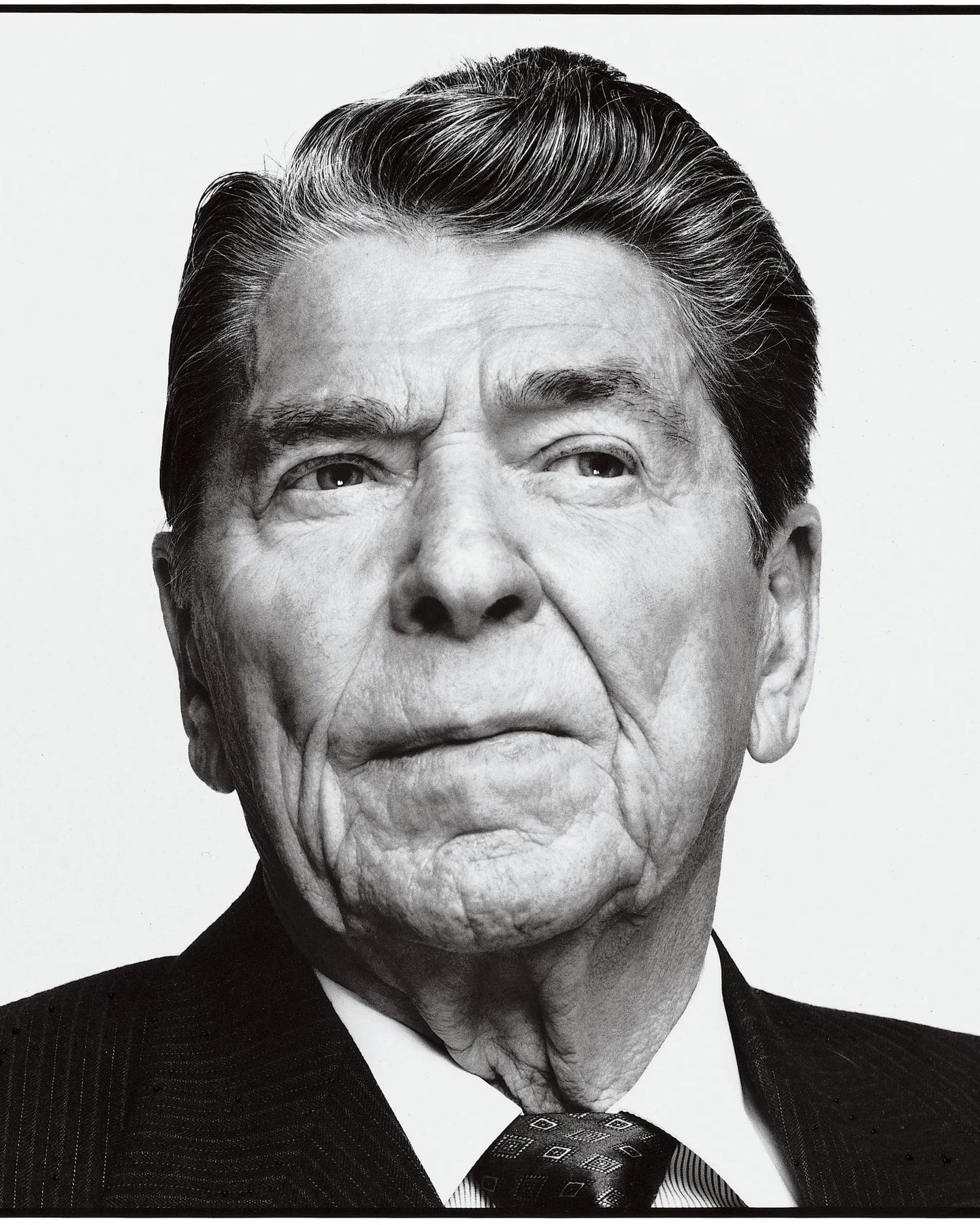
Ronald Reagan.

President · Governor · Actor

Ronald Reagan moved from Iowa sports radio to Hollywood sets, from Screen Actors Guild fights to General Electric speaking tours, and then into the California governorship and the White House. The public style was famously smooth, but the sharper pattern underneath was a man who trusted the immediate read of the moment and could make that read sound like common sense.

OBJECTIVE PERSONALITY CLASSIFICATIONMF-Se/Fi-CP/B(S) #2What does this mean?
PERSONALITY SYSTEMObjective Personality
LEAD FUNCTIONSe · Extroverted Sensing
SECOND SAVIOR FUNCTIONFi · Introverted Feeling
MBTI EQUIVALENTESFP
01 / BEHIND THE CLASSIFICATION

The personality behind the fame.

How does a recorded OPS classification like MF-Se/Fi-CP/B(S) #2 break down? Walk through nine coins and watch the proposed type take shape. These are deductions from the archived code, not independent evidence of typing accuracy.

Scroll below to see Ronald Reagan take shape.

STARTING POINT512 possible OPS typesEach type combines core functions, an animal order, and sexual modalities.
THE FINISH LINEMF-Se/Fi-CP/B(S) #2One recorded classification, decoded from its components.
Ronald Reagan’s HUMAN NEEDS 01—03
01
DECIDER OR OBSERVER?

Observer over Decider

Observers have more balanced Decider poles in the middle: Self (Di) and Tribe (De). Their own perspective and other people's perspectives tend to be easier to navigate. Things are the harder territory. Control (Oi) and Chaos (Oe) sit at the extremes, so disrupted plans, uncertainty, and a changing world can trigger the strongest reactions.

Reagan’s public life kept turning on conditions he believed had to be dealt with: a California budget deficit, late-1970s stagflation, and the strategic pressure of the Cold War. He built his appeal as the man who would step into disorder and make the picture legible again. That is Observer friction—less a battle over personal worth than a battle with systems, timing, and an environment that feels off course. The strength is calm momentum when circumstances are unstable. The blind spot is making complicated realities sound more governable, and more binary, than they actually are.
O
02
SELF OR TRIBE?

Di · Self over De · Tribe

Self (Di) is the stronger deciding pole. They check decisions against their own values or reasons first: what makes sense to me, what feels right to me? The strength is independent conviction; the recurring friction is the Tribe (De)—other people's standards, feedback, and expectations. As the portrait unfolds, notice how Self takes the lead.

When Reagan gave "A Time for Choosing," he did not sound like a man polling the room for permission. The same streak showed up in California when he accepted major tax increases to close the deficit and took heat from conservatives who called it betrayal. Self over Tribe does not mean isolation; it means his standard often started inside his own read of what fit. That can create unusual steadiness under pressure. The cost is obvious: once a person trusts his own judgment that strongly, criticism can look less like correction and more like background noise.

Di
03
GATHER OR ORGANIZE?

Oe · Gather over Oi · Organize

Gather (Oe) leads with new information, experiences, and possibilities. Its strength is curiosity and adaptability; the recurring friction is narrowing the options and settling into what is already known. Another layer of the personality portrait comes into focus.

Reagan’s career was not a neat ladder. He moved from Iowa sports radio to Hollywood, from Screen Actors Guild leadership to General Electric hosting and plant speeches, then into statewide and national politics. Gather over Organize fits that opportunistic range: another arena, another audience, another opening to work. The strength is flexibility with changing landscapes and media. The tradeoff is that breadth can outrun selectivity. A life built by seizing live openings can make a later, narrower long-range discipline feel confining, even when that discipline would prevent costly overreach.

Oe
FIRST THREE COINSO + Di + Oe

These establish the preferred human needs in the OPS framework.

Ronald Reagan’s FUNCTIONS 04—05
04
FEELING OR THINKING?

Feeling · F over Thinking · T

Feeling (F) evaluates decisions through values, meaning, and what matters—not simply through emotion. Its strength is a clear sense of significance; Thinking (T) provides balance through impersonal reasons, consistency, and evidence. Combined with Self (Di), this forms the recorded Savior Fi.

Feeling shows up in Reagan less as sentimentality than as personal moral framing. As a student, he invited Black teammates to his parents’ home after a segregated hotel refused them service; in Hollywood he spoke against racism and appeared on Operation Terror condemning Ku Klux Klan violence. Fi gives that private standard real bite: he wanted to act from what he believed was right, not merely what was strategic. The strength is conviction that reads as authentic. The blind spot is that a sincerely held value can still leave enormous public arguments unresolved about policy, evidence, and consequences.

F → Fi
05
SENSING OR INTUITION?

Sensing · S over Intuition · N

Sensing (S) focuses on concrete details, observable reality, and lived experience. Intuition (N) balances it by looking for broader patterns, concepts, and implications. Combined with Gather (Oe), this gives the recorded Savior Se.

Before national politics, Reagan made his living turning thin, concrete cues into vivid present-tense experience. At WHO radio he reconstructed baseball games from wire reports, and in film he was known for a simple, direct acting style that followed the scene in front of him. Se fits that knack for what is immediately there: the audience, the line, the moment, the visible opening. The strength is communicative clarity and timing. The cost is that immediate reality can feel so compelling that slower pattern questions—what this adds up to later—receive less weight than they need.

S → Se
THE TWO SAVIOR FUNCTIONSSe / Fi

Opposing functions: Ni and Te.

Ronald Reagan’s ANIMAL STACK 06—07
06
CONSUME OR BLAST?

Consume over Blast

Consume gathers information for internal processing; Blast organizes and communicates information. The recorded order is Consume → Play → Blast → Sleep. This comparison follows their positions in that stack.

Reagan spent years taking in material before he became a national political force: sports copy on the radio, studio labor fights at SAG, company tours and employee conversations while speaking for General Electric. Consume has something to work with because it keeps gathering texture from the world first. That depth helped give later speeches a practiced ease. Blast sits later, not absent. The blind spot is that more input can feel productive even when the real challenge has shifted from learning the material to reducing it into a sharper, more accountable conclusion.

C > B
07
PLAY OR SLEEP?

Play over Sleep

Play emphasizes external real-time engagement; Sleep emphasizes internal processing. The recorded stack places Play earlier.

Reagan’s life kept moving through live exchange: labor disputes at the Screen Actors Guild, campaign stops across California, and later negotiations with Mikhail Gorbachev. Play over Sleep points to a preference for meeting events in motion, where the next response gets shaped with and against other people in real time. The strength is momentum and social adaptability under pressure. The cost is subtler. Constant outward engagement can crowd out the quieter internal pause that asks whether the line still holds up once the room is gone and the adrenaline has dropped.

P > S
Ronald Reagan’s ANIMAL ORIENTATION 08—09
08
INFO OR ENERGY DOMINANT?

Info over Energy

Info dominant means Consume and Blast are both in the top three: gathering and communicating information are more balanced. Sleep last leaves the energy side uneven—Play can keep engagement going without enough private recovery.

His stack lands on Info over Energy, which tracks the public shape of his career unusually well. Reagan repeatedly gathered material and then packaged it for an audience—first as a broadcaster, then as a corporate speaker, then as a president whose political force depended on making a large story sound simple enough to repeat. That balance can be formidable. The missing weight is Sleep, the fourth animal: less priority on stepping back, consolidating privately, and letting complexity sit before the next clean delivery. Strong messaging can keep moving even when deeper recalibration is overdue.

Info
09
INTROVERSION OR EXTROVERSION?

Extroversion over Introversion

The last animal, Sleep, determines this OPS coin: Play or Blast last means Introversion; Consume or Sleep last means Extroversion. This describes animal orientation, not sociability or shyness.

Sleep comes last, which makes this an OPS Extroversion result—not a claim that Reagan was merely sociable, but that his stack more readily moves outward through gathering, engaging, and broadcasting than inward through prolonged private processing. That fits a life built in front of microphones, cameras, rallies, treaty rooms, and executive office. The strength is forward motion: he could keep contact with the outer world and keep shaping it publicly. The growth cost is that quiet re-checking becomes the harder discipline. Without it, confidence can stay high after the facts underneath it have gotten messier.

E
Sexual Modalities

The four sexual modalities.

OPS uses masculine/feminine sensory and extroverted-deciding distinctions as framework-specific terms, not gender categories. The four modalities are already included in the original 512 types. The recorded modality is MF · Audio.

MM KinestheticMasculine Sensory · Masculine De
MF RECORDED MODALITYAudioMasculine Sensory · Feminine De
FF TesterFeminine Sensory · Feminine De
FM VisualFeminine Sensory · Masculine De
ADDITIONAL LAYER · SOCIAL TYPE

The four social types.

Social types are an additional layer on top of the original Objective Personality classification, introduced later in OPS research. They describe two proposed social preference coins: Flex vs. Friends and Generalize vs. Specialize. The combination and priority of these preferences produce four social types. Ronald Reagan's recorded social type is #2.

SOCIAL #1 #1Flex · Generalize
SOCIAL #2 RECORDED SOCIAL TYPE#2Generalize · Friends
SOCIAL #3 #3Specialize · Flex
SOCIAL #4 #4Friends · Specialize
COMPLETE RECORDED OPS TYPE · MODALITY INCLUDED + SOCIAL TYPEMF-Se/Fi-CP/B(S) #2

Se leads, Fi supports, and the animal stack is Consume → Play → Blast → Sleep.

THE FINISHED PORTRAIT · ALL NINE COINS REVEALED

Ronald Reagan's complete function and animal stack

ConsumePlayBlastSleepmSemFifTefNi
MF-Se/Fi-CP/B(S) #2DOUBLE ACTIVATED · PLAYExplore the Interactive Coin Builder →
THE RONALD REAGAN LENS

The polished certainty had a cost.

Before Reagan was the "Great Communicator," he was the announcer turning wire-service baseball updates into a game you could almost see. Later, "A Time for Choosing" made him a national conservative force. The public impression was smooth confidence. Behind it was a man who trusted the next visible opening and knew how to make it sound inevitable.

Se/Fi helps explain that mix of immediacy and conviction. Reagan read the room, the camera, and the present-tense pressure, then attached it to a personally owned moral frame. That pairing can make leadership feel vivid and decisive. Its limit is just as visible: a message can sound morally settled before the longer-range complexity, tradeoffs, or downstream costs have fully caught up.

As an Observer and therefore a Double Decider—the exact Atlas pairing for every Observer—Reagan’s recurring strain centers less on people drama than on what the world is doing and where it is heading. Every Decider, in the same system, is likewise a Double Observer. The imbalance is energy spent managing circumstances over slower pattern-tracking. Neglected Ni, opposite his lead Se, asks what today’s vivid move becomes if the trend keeps running.

Consume → Play → Blast → Sleep captures the rhythm: take in, engage, tell the story, then—last—step back. That last-animal imbalance made Reagan publicly potent, but it also makes private re-checking easier to postpone than the next persuasive push. The better balance is not duller messaging. It is preserving his directness while forcing major decisions through a quieter written review of long-range consequences before the speech, summit, or signature.

Want to understand the Savior and Demon states behind these nine coins? Explore the complete explanation, visual examples, and typing principles on our Methodology page →

02 / KEEP EXPLORING

Different faces. Familiar patterns.

Explore other celebrities with related recorded OPS classifications. Related functions are not necessarily exact type matches.

Discover Type Twins
YOUR TURN

Curious about your own type?

Discover how your own personality might be classified through Objective Personality.

Get objectively typed
Ronald Reagan's Personality Type & OPS Profile | The Personality Atlas