The Personality Atlas
THE CELEBRITY PERSONALITY ARCHIVE / FILM & STAGE

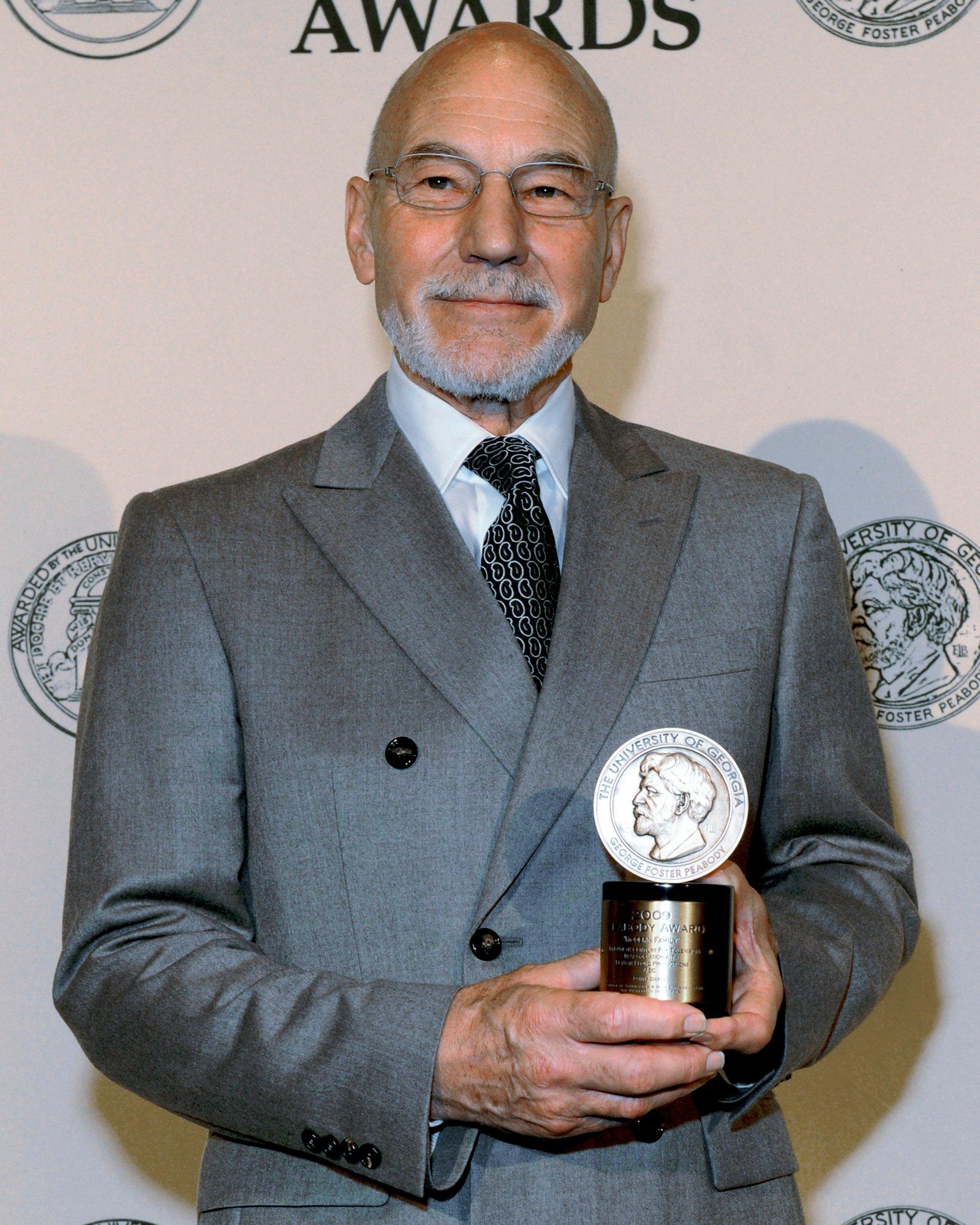
Patrick Stewart.

Actor · Stage and screen icon

From more than sixty Royal Shakespeare Company productions to the captain’s chair of Star Trek and the wheelchair of Professor Xavier, Patrick Stewart turned classical discipline into mainstream authority. The image is command: clipped diction, steel posture, a voice that can bless or reprimand. Yet the career underneath is less settled than it looks—a repertory actor who kept reinventing the stage on television, in blockbuster franchises, and even in a one-man Dickens show.

OBJECTIVE PERSONALITY CLASSIFICATIONFF-Ne/Te-PC/S(B)What does this mean?
PERSONALITY SYSTEMObjective Personality
LEAD FUNCTIONNe · Extroverted Intuition
SECOND SAVIOR FUNCTIONTe · Extroverted Thinking
MBTI EQUIVALENTENFP
01 / BEHIND THE CLASSIFICATION

The personality behind the fame.

How does a recorded OPS classification like FF-Ne/Te-PC/S(B) break down? Walk through nine coins and watch the proposed type take shape. These are deductions from the archived code, not independent evidence of typing accuracy.

Scroll below to see Patrick Stewart take shape.

STARTING POINT512 possible OPS typesEach type combines core functions, an animal order, and sexual modalities.
THE FINISH LINEFF-Ne/Te-PC/S(B)One recorded classification, decoded from its components.
Patrick Stewart’s HUMAN NEEDS 01—03
01
DECIDER OR OBSERVER?

Observer over Decider

Observers have more balanced Decider poles in the middle: Self (Di) and Tribe (De). Their own perspective and other people's perspectives tend to be easier to navigate. Things are the harder territory. Control (Oi) and Chaos (Oe) sit at the extremes, so disrupted plans, uncertainty, and a changing world can trigger the strongest reactions.

When Patrick Stewart took Star Trek: The Next Generation, he was not mainly wrestling with whether Hollywood respected him enough. He was wrestling with the situation itself: an unknown revival, brutal 4:45 a.m. television calls, and a genre he had once openly questioned. That is Observer pressure—circumstances first, people second. His strength is adaptability under unstable conditions; the Yorkshire stage actor could learn spacecraft jargon and make it feel regal. The blind spot is waiting for the environment to feel properly ordered before relaxing. Sometimes the world never tidies itself first.

O
02
SELF OR TRIBE?

De · Tribe over Di · Self

Tribe (De) is the stronger deciding pole. They check decisions against people, shared standards, and what works for the group: what do we need, what will others think? The strength is coordination and responsiveness; the recurring friction is the Self (Di)—knowing and defending their own position. As the portrait unfolds, notice how Tribe takes the lead.

Stewart’s famous early rebuke to the Next Generation cast—“We’re not here ... to have fun!”—was severe, but revealing. He was tracking the group’s standard, not merely protecting a private preference. Later, he also became an advocate for fellow actors with producers, and castmates credited his professionalism with raising the whole set. Tribe over Self can create enormous reliability: he knows how work should function between people. The cost is that carrying the group’s competence can become a burden, and correction can land harder than intended when the standard matters more than the mood.

De
03
GATHER OR ORGANIZE?

Oe · Gather over Oi · Organize

Gather (Oe) leads with new information, experiences, and possibilities. Its strength is curiosity and adaptability; the recurring friction is narrowing the options and settling into what is already known. Another layer of the personality portrait comes into focus.

Few careers look less boxed in than Stewart’s: Royal Shakespeare Company stalwart, reluctant sci-fi captain, Dickens solo performer, sitcom guest, animated spymaster, superhero mentor. Gather over Organize helps explain that range. Another role, another genre, another experiment can be useful rather than threatening. It is the advantage of staying open long enough for an “unknown British Shakespearean actor” to become a global franchise anchor. The tradeoff is selectivity. A life rich in possibilities can still leave a “gaping hole” somewhere else, as Stewart said happened to his Shakespeare résumé during the Star Trek years.

Oe
FIRST THREE COINSO + De + Oe

These establish the preferred human needs in the OPS framework.

Patrick Stewart’s FUNCTIONS 04—05
04
FEELING OR THINKING?

Thinking · T over Feeling · F

Thinking (T) evaluates decisions through reasons, logic, and what works—not a lack of emotion. Its strength is analytical consistency; Feeling (F) provides balance through values, meaning, and the human consequences of a decision. Combined with Tribe (De), this forms the recorded Savior Te.

Stewart’s public authority is not just a great voice; it is a visible standard of execution. Jonathan Frakes said Stewart set such a high bar for preparation that everyone came in having read and broken down the script. Even as a teenager selling furniture, he reportedly tailored his pitch customer by customer—results mattered. Thinking here shows up as external effectiveness: organize the work, meet the standard, raise the room. The blind spot is obvious in that same reputation. Efficiency can inspire trust, but it can also make warmth feel secondary or late.

T → Te
05
SENSING OR INTUITION?

Intuition · N over Sensing · S

Intuition (N) focuses on concepts, patterns, and what information might mean. Sensing (S) balances it through observable facts, physical detail, and direct experience. Combined with Gather (Oe), this gives the recorded Savior Ne.

Stewart repeatedly turns a role by reframing its meaning. He decided Jean-Luc Picard should be played like a figure from Henry IV. He pursued a “photo negative” Othello that inverted the play’s racial assumptions. He turned A Christmas Carol into a one-man performance of more than forty characters. That is Intuition at work: spotting the larger concept that makes familiar material newly alive. The gift is reinvention without panic. The growth cost is that a powerful framing idea can look so convincing that slower practical constraints—time, contracts, typecasting, age, production realities—arrive as unwelcome interruptions.

N → Ne
THE TWO SAVIOR FUNCTIONSNe / Te

Opposing functions: Si and Fi. This is a jumper classification.

Patrick Stewart’s ANIMAL STACK 06—07
06
PLAY OR SLEEP?

Play over Sleep

Play emphasizes external real-time engagement; Sleep emphasizes internal processing. The recorded stack places Play earlier.

Play arrives earlier than Sleep in Stewart’s stack, and his career makes that easy to picture. He spent decades in repertory companies, worked repeatedly with Ian McKellen, loosened into the ensemble culture of Star Trek after his stiff beginning, and kept jumping into collaborative screen and voice projects. Play gives him traction through live exchange, not just private rumination. The strength is responsive engagement with other people and changing scenes. The cost is that Sleep comes later: internal settling may lag behind activity, so the machine can keep moving before the experience has fully condensed.

P > S
07
CONSUME OR BLAST?

Consume over Blast

Consume gathers information for internal processing; Blast organizes and communicates information. The recorded order is Play → Consume → Sleep → Blast. This comparison follows their positions in that stack.

After Play before Sleep, the next useful clue is that Consume also comes before Blast. Stewart’s career is stuffed with intake: more than sixty RSC productions, literary readings, narration, one-man adaptations, and the painstaking absorption needed to carry Shakespeare, Dickens, Star Trek, and X-Men without flattening them into the same performance. Consume gives depth of material. Blast later means the reduced, final message can take longer to harden. He can command a stage instantly, yet still prefer more study, more context, more texture before boiling everything down for other people.

C > B
Patrick Stewart’s ANIMAL ORIENTATION 08—09
08
INFO OR ENERGY DOMINANT?

Energy over Info

Energy dominant means Play and Sleep are both in the top three: there is access to expending energy through engagement and conserving it through internal processing. Blast last leaves the information side uneven—Consume may gather far more than gets communicated.

Stewart’s top three animals include both outward engagement and private recovery, which is why this profile lands on Energy rather than Info. The public evidence is unusually broad: ensemble television, stage partnerships, comic voice work alongside solo pieces like A Christmas Carol. He can spend energy with people and still retreat enough to consolidate craft. The void is Blast last. For all the unmistakable authority of his voice, the harder move may be simplifying accumulated experience into a plain, repeatable directive. More material keeps arriving; blunt synthesis is the expensive step.

Energy
09
INTROVERSION OR EXTROVERSION?

Introversion over Extroversion

The last animal, Blast, determines this OPS coin: Play or Blast last means Introversion; Consume or Sleep last means Extroversion. This describes animal orientation, not sociability or shyness.

Patrick Stewart can fill a theater, headline global franchises, and still land on the OPS Introversion coin. The reason is not shyness and not a lack of social range. It is that Blast sits last: final outward declaration comes after interaction, intake, and private processing. You can see that tension in a man who led Star Trek yet kept missing the stage enough to build one-man shows and return to Shakespeare. The strength is substance before proclamation. The blind spot is delaying the clean conclusion, leaving others to infer the larger thesis from exceptional performances.

I
Sexual Modalities

The four sexual modalities.

OPS uses masculine/feminine sensory and extroverted-deciding distinctions as framework-specific terms, not gender categories. The four modalities are already included in the original 512 types. The recorded modality is FF · Tester.

MM KinestheticMasculine Sensory · Masculine De
MF AudioMasculine Sensory · Feminine De
FF RECORDED MODALITYTesterFeminine Sensory · Feminine De
FM VisualFeminine Sensory · Masculine De
COMPLETE RECORDED OPS TYPE · MODALITY INCLUDEDFF-Ne/Te-PC/S(B)

Ne leads, Te supports, and the animal stack is Play → Consume → Sleep → Blast.

THE FINISHED PORTRAIT · ALL NINE COINS REVEALED

Patrick Stewart's complete function and animal stack

PlayConsumeSleepBlastmNemFifTefSi
FF-Ne/Te-PC/S(B)DOUBLE ACTIVATED · CONSUMEExplore the Interactive Coin Builder →
THE PATRICK STEWART LENS

Authority with a restless engine

Patrick Stewart’s public image hardened around command: Picard in the captain’s chair, Xavier in the school, that voice turning almost any line into an order. But one revealing detail is that he began Star Trek living out of a suitcase, convinced the show would fail. Behind the authority was a stage actor adapting fast to a world he did not fully trust.

His Ne/Te pairing is excellent at taking a new situation and making it workable. Stewart could frame Picard through Shakespeare, raise a cast’s preparation standard, and move from classical theater to blockbuster franchises without losing precision. The limit is that constant adaptation plus external standards can make life feel like a sequence of problems to solve, leaving less patience for routine or softer forms of communication.

As an Observer and Double Decider, Stewart’s central imbalance is not chiefly people drama but unstable conditions and changing contexts. That exact pairing matters: an Observer is a Double Decider, so self-versus-tribe judgments are more manageable than the shifting world itself. Neglected Si sits opposite his lead Ne, making settled routine, repetition, and familiarity the underfed side of an otherwise agile career.

Play → Consume → Sleep → Blast explains why he can look commanding without living in constant proclamation. Blast last creates the imbalance: rich experience may arrive faster than the final distilled message. The useful correction is not less curiosity or less collaboration, but naming the thesis earlier—at rehearsals, on sets, and in planning—so others get the conclusion before the full library arrives.

Want to understand the Savior and Demon states behind these nine coins? Explore the complete explanation, visual examples, and typing principles on our Methodology page →

02 / KEEP EXPLORING

Different faces. Familiar patterns.

Explore other celebrities with related recorded OPS classifications. Related functions are not necessarily exact type matches.

Discover Type Twins
YOUR TURN

Curious about your own type?

Discover how your own personality might be classified through Objective Personality.

Get objectively typed
Patrick Stewart's Personality Type & OPS Profile | The Personality Atlas